

Skilled H-2A Program Jobs: How to Define Duties, Skills, and Qualifications
The H-2A Visa Program is essential to helping U.S. farms and ag businesses find and hire the seasonal farm labor they need to perform all the work involved with managing livestock, harvesting crops, and maintaining America’s food supply.
In a recent blog, we talked about why it’s so important for the job duties detailed in the ETA-790 to match the actual duties workers perform once they arrive. This is even more critical when you move beyond general farm labor into more advanced, skilled worker positions.
This blog is designed to help ag businesses understand the most common skilled H-2A Program worker positions and how to distinguish which one might be the best fit for specific situations. We’ve provided examples of how the Job Order descriptions might look for each, as well as best practices for identifying specific job requirements to determine which category makes the most sense for your needs.
Job Order accuracy is critical
It’s essential to clearly define the job you’re offering and write the job description to match—since the Job Order is the primary document used for recruiting, H-2A compliance, and wage determination. If the ETA-790 doesn’t accurately reflect the actual tasks to be performed, it can potentially create several issues:
You may end up hiring workers who don’t have the right skills
You may discourage U.S. candidates from applying
If the actual duties performed vary it becomes an H-2A compliance issue
It may result in you paying the wrong wage, opening you up to potentially paying back wages. Under the current H-2A Program wage system, DOL establishes AEWRs at Skill Level I and Skill Level II, and the skill level reflects wage differences associated with qualifications.
For example:
You shouldn't casually add "Must diagnose and repair hydraulic and electrical systems," to a general farm-labor position without considering what that does to the occupational classification and skill requirements.
5 key categories of skilled H-2A Program labor
Here are the most common categories of skilled seasonal farm labor:
Equipment Operation
Maintenance work
Mechanical work
Repair work
Construction
This provides a high-level summary of key tasks and potential H-2A Program concerns:
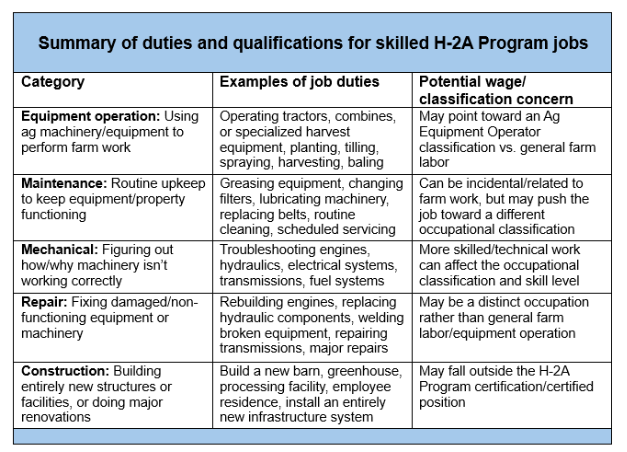
It’s likely jobs will have tasks that overlap these definitions. Your goal is to clearly describe the job being offered, including the specific skills and qualifications required.
Let’s dive deeper into each one to clarify the key duties and skills of each. This will help you more accurately identify when to classify your job opportunities as one versus another.
Equipment Operation
An Ag Equipment Operator primarily operates machinery to perform agricultural production activities.
Think: Getting agricultural work done using equipment
Here are some examples of job duties that might be required of and performed by Ag Equipment Operators:
Operate tractors
Disk/harrow fields
Plant crops
Cultivate crops
Spray crops
Operate combines
Operate forage harvesters
Operate cotton pickers
Operate specialized vegetable harvesting equipment
Operate balers
Operate loaders as part of agricultural production
Operate irrigation equipment, depending on the actual work
Adjust equipment during field operations
Here’s how an Ag Equipment Operator’s job description might be worded on an ETA-790A:
Ag Equipment Operator: Operate tractors and other farm equipment to plant, cultivate, spray, harvest, and perform other agricultural field operations.
Maintenance Work
Think: Preventing problems, keeping equipment operational, rather than fixing a significant failure
Here are some examples of job duties that might be required of and performed by a Maintenance Worker:
Lubricating machinery
Greasing bearings
Changing engine oil
Changing filters
Checking fluid levels
Replacing worn belts
Tightening bolts
Routine equipment cleaning
Routine inspection
Scheduled preventive maintenance
Basic adjustments
Replacing routine wear items
These duties may be reasonably related to equipment operation. A useful approach is to distinguish between routine/incidental maintenance that supports agricultural production and a position whose primary purpose is skilled mechanical, construction, electrical, plumbing, or other non-agricultural work.
Here’s how an Ag Maintenance Worker’s job description might be worded on an ETA-790A:
Agricultural Maintenance Worker: Perform routine maintenance and upkeep of agricultural equipment, farm buildings, fences, and other farm infrastructure. Duties include routine inspections of equipment and facilities, performing minor adjustments, replacing worn or damaged components, and assisting with general maintenance necessary to support agricultural production.
This is different than:
"Worker independently services and maintains the farm's entire fleet of tractors, combines and harvest equipment."
The latter leans more toward a Mechanic job position.
Mechanical work
Mechanical work moves into diagnosis and technical troubleshooting.
Think: Figuring out what's wrong and how the mechanical system works
Here are some examples of job duties that might be required of and performed by a Mechanic:
Diagnose engine problems
Troubleshoot hydraulic systems
Diagnose electrical problems
Troubleshoot transmissions
Adjust engine systems
Diagnose fuel-system problems
Test mechanical components
Disassemble/reassemble machinery
Perform mechanical adjustments
Troubleshoot drive systems
Here’s how a Mechanic’s job description might be worded on an ETA-790A:
Agricultural Machinery Mechanic: Inspect equipment and use diagnostic tools to identify malfunctions. Repair mechanical, hydraulic, electrical, and fuel-system problems on tractors, combines, sprayers, irrigation equipment, and other agricultural machinery. Repair or replace defective components, wiring, hoses, pumps, hydraulic cylinders, belts, filters, and other parts. Test equipment after repairs to ensure proper operation.
If the position combines operating equipment with mechanical work, the ETA-790 should specify both. Here’s how it might be worded:
Agricultural Equipment Mechanic/Operator: Perform mechanical inspection, diagnosis, and repair of tractors, combines, sprayers, and other agricultural machinery. Replace defective parts and make necessary mechanical, hydraulic, and electrical repairs. Operate agricultural equipment as needed to test equipment following repairs and to assist with planting, cultivating, spraying, harvesting, and other agricultural production activities.
Repair work
Think: Repairing/replacing/restoring equipment that is damaged, has broken, or has malfunctioned
Here are some examples of job duties that might be required of and performed by an Ag Equipment Repair Worker:
Repair tractor engines
Repair transmissions
Replace hydraulic pumps
Repair hydraulic cylinders
Replace electrical components
Repair braking systems
Replace damaged mechanical components
Weld broken equipment
Rebuild machinery
Repair harvest equipment
Repair irrigation machinery
Here’s how a Repair Worker’s job description might be worded on an ETA-790A:
Agricultural Equipment Repair Worker: Diagnose and repair agricultural machinery and equipment that breaks down or malfunctions during farming operations. Dismantle defective equipment and components, repair or replace damaged or worn parts, and reassemble equipment following repairs. Test equipment after repair and make necessary adjustments to ensure proper operation. Equipment may include tractors, harvesters, planters, cultivators, trailers, and other machinery used in agricultural production.

Construction work can be particularly problematic
Imagine a vegetable farm is expanding its irrigation system. An H-2A Program worker might legitimately perform agricultural work such as installing, maintaining and repairing irrigation lines used to water the crops. But if the worker spends several months functioning essentially as an irrigation-construction laborer, installing an entirely new commercial irrigation system, that’s substantially different.
Think: Creating something new or substantially altering an existing structure/system
Here are some examples of job duties that might be required of and performed by a Construction Worker:
Build a new barn
Construct a new greenhouse
Build a new processing facility
Construct a new employee residence
Build a new commercial building
Install an entirely new irrigation system
Whether or not the construction work falls within the H-2A Program depends on:
Who performs the work
Where it’s performed
What is being built/repaired
Whether it’s integral to the agricultural operation
Proportion and nature of the duties
Whether or not it satisfies DOL's definition which includes services performed for the operator of a farm “in connection with the operation, or maintenance of such farm and its tools and equipment”
Examples that are likely to fit within the H-2A Program:
Agricultural Construction Worker: Build, repair, and remodel agricultural buildings and structures used in the employer's farming operation, including livestock barns, shelters, equipment sheds, and related agricultural structures. Duties may include repairing walls, roofs, doors, gates, curtains, feed systems, and other components; installing agricultural fixtures and equipment; and performing minor concrete work.
Livestock Facility Construction and Repair Worker: Construct, repair, and maintain livestock facilities used in the production and care of cattle or other livestock. Install gates, fencing, feeders, feed lines, ventilation equipment, curtains, water lines, and other livestock facility components. Repair damaged walls, doors, roofs, and other portions of agricultural buildings and structures.
Examples that may not have a clear connection to ag production and, therefore, the H-2A Program:
Construction Worker: Construct new residential homes, including framing, roofing, drywall, electrical, plumbing, flooring, painting, and installation of fixtures.
Construction Laborer: Perform construction of commercial buildings, including excavation, concrete foundations, framing, roofing, drywall, electrical, plumbing, and general building construction.
The actual job structure matters
As far as wages are concerned, here’s the general process:
Job duties → occupational classification → skill level → AEWR
The most important thing to be aware of is that, under the current AEWR methodology, DOL doesn’t simply choose one SOC based on the job title. It looks at the duties performed and the qualifications required and can assign multiple SOC codes to a single H-2A Program job opportunity.
For H-2A Program occupations outside the five combined field/livestock SOC categories, DOL determines the applicable SOC code(s) based on:
The duties performed for the majority of the workdays during the contract period (which doesn’t mean what consumes the most hours), and
The qualifications contained in your Job Order
If more than one SOC code applies to the job opportunity, the highest applicable AEWR becomes the AEWR for the job opportunity (for all hours).
Qualifications matter, too
DOL doesn't look only at what the worker physically does. The regulation also expressly considers the qualifications contained in the H-2A Program Job Order when determining the occupational classification and applicable AEWR.
Compare:
Position A: Operate tractors and other farm machinery. No prior experience required. Employer provides training.
versus:
Position B: Operate, diagnose, maintain and repair tractors and agricultural equipment. Minimum 2 years' experience repairing diesel engines and hydraulic systems required.
The second position communicates a substantially different skill and qualification profile.
Bottom line best practices
Asking these practical questions can help you fine-tune the tasks, skills, and qualifications for your seasonal farm labor:
What is the actual work to be done?
Why is it being performed?
How substantial is it?
Is it considered agricultural under the applicable definition?
Is it accurately represented in the certified Job Order?
Would the tasks, skills, and qualifications be clear to a potential U.S. candidate?
USA Farm Labor knows how to craft job descriptions that work
USA Farm Labor specializes in helping U.S. ag businesses find, interview, and hire skilled H-2A Program workers. This is just one of the services we provide as part of our efforts to help American farms build a more predictable ag workforce. We’re constantly investing to improve the quality of H-2A Program workers, and our partnership with USA Truck Labor helps provide workers that’ve received training on core American farm operation tasks, as well as how to drive American-style trucks, perform equipment inspections and maintenance, and ensure safety. The nuances in these skilled job positions can be tricky, so it can be invaluable to have an expert by your side to help ensure your job descriptions clearly describe your needs, required qualifications, and the right classification.
