

Is Your H2A Job Order Accurate?: Why Actual Worker Duties Matter
As USA Farm Labor helps farms and ag operations move forward with their H2A Visa Program applications, one of the key aspects of the H2A application process that we field lots of questions on has to do with the Job Order. This documentation, known collectively as the ETA-790 and ETA-790A, is much more than just a form or application. It plays a major role throughout the entire H2A process and contract period. That’s why it’s essential to make sure it’s accurate and complete.
This blog is designed to help ag operations participating in the H2A Program clearly understand what the ETA-790 is, why it’s so important, what it needs to include, and what key questions to answer before it’s submitted. You’ll also find a useful template for creating clear, compliance-ready Job Orders.
What is the ETA-790/790A?
The ETA-790/790A is essentially the official H2A Program Job Order. It tells the U.S. Department of Labor (DOL) and State Workforce Agency (SWA) exactly what agricultural job you’re offering and under what terms, while allowing the government to recruit U.S. workers before you receive your H2A Visa Program certification.
What roles does the ETA-790/790A play within the H2A process?
It kickstarts the process to get your Temporary Labor Certification
Submitting your ETA-790/790A is Step 1 in the process to get your Temporary Labor Certification (TLC), which is required before you can hire H2A Program workers. For a standard H2A Visa Program filing, your Job Order generally needs to be submitted 75 – 60 calendar days before the start date of your need period. It’s important to note that the ETA-9142A is your actual application for your TLC which is the request to DOL to certify your need for H2A Program workers.
It describes the job, terms, and duties for the H2A Program position
The ETA-790/790A, or Job Order, establishes the terms and conditions of employment you must honor for your H2A Program position. The ETA-790A is the official Job Order that tells DOL exactly what workers you need, what they’ll be doing, where and when they’ll work, and what you’ll pay them.
It establishes the basis for required U.S. worker recruitment to see if there are qualified, willing domestic workers available
You’re required to make the job available to qualified U.S. workers before DOL will certify your need for H2A Program workers. The H2A Visa Program is designed to help fill seasonal agricultural labor gaps when sufficient qualified and willing domestic labor is unavailable. The SWA uses your Job Order to post the position in its intra/interstate clearance system to facilitate recruitment of U.S. workers.
It supports the ETA-9142A application
The ETA-790/790A establishes and advertises your job opportunity. The ETA-9142A is used to apply for your Temporary Labor Certification.
Here’s a simple way to look at it:
ETA-790A = "Here’s the job we're offering."
ETA-9142A = "We’re asking DOL to certify that we need these foreign workers for that job."
Think of the H2A Program process this way:
ETA-790/790A → ETA-9142A → U.S. worker recruitment → Temporary Labor Certification → USCIS → Consulate/Visa → Workers
It serves as an ongoing compliance tool
Your ETA-790/790A becomes an essential part of determining whether or not you’re satisfying H2A compliance requirements. Which means the information in the ETA-790/790A matters after certification, too. DOL's Wage and Hour Division says you must accurately follow the terms and conditions detailed in your Job Order. Mistakes or omissions can create problems later in the H2A Program process or create compliance issues after workers arrive. For example, you can’t advertise one wage to workers and then pay something different, or list one type of work and then substantially use H2A Program workers for work outside the approved scope. You’ll find more details on H2A compliance below.
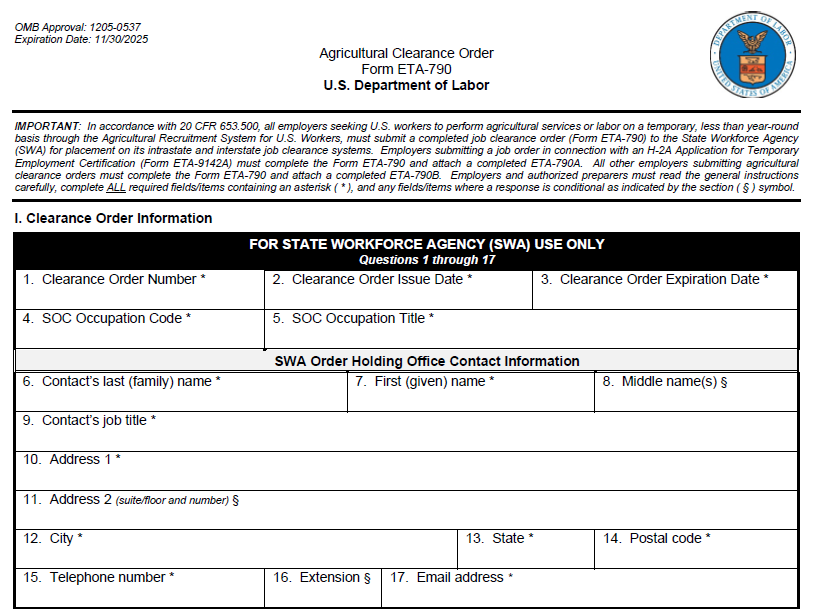
What’s the difference between the ETA-790 and ETA-790A?
Your ETA-790 and ETA-790A aren’t two separate H2A Job Orders. They’re two parts of the same H2A Agricultural Clearance Order. While you’ll often hear people refer to the complete package, the combined ETA-790 and ETA-790A, as the "ETA-790," the DOL refers to the combined filing as Form ETA-790/790A.
Here’s an easy way to summarize it:
ETA-790 = the overall agricultural job clearance order that identifies the Job Order and initiates the clearance/recruitment process
ETA-790A = the detailed H2A-specific job information, material terms, conditions, and assurances
ETA-790/790A = the complete H2A Job Order package submitted through FLAG
What is actually on the ETA-790A?
The ETA-790A is where the real meat of the H2A Program job opportunity is documented. It contains information such as:
Job title
Number of workers requested
Start and end dates
Work schedule/hours
Wage rate
Crops and/or agricultural activities
Tools/equipment requirements
Job duties
Minimum job requirements
Employer and worksite information
Housing information
Transportation information
Meals and other employment terms
Employer assurances
Why actual worker duties should match the certified Job Order
Your certified H2A Program Job Order defines the job for which you received DOL’s approval to use H2A Program workers. Your certification is tied to you as the employer, your specific location, need period, crops/activities, duties, and employment terms.
For example, if your Job Order specifies you need “20 workers to harvest apples and perform orchard maintenance," but you primarily use those workers for an activity not included in your certified Job Order, there’s a disconnect between the job DOL certified and the job your workers are actually performing.
Here’s why it’s so important for certified and actual duties to match:
The H2A Program certification is tied to the specific job opportunity
The Job Order is part of your labor-certification process. DOL uses it to determine what job is being offered to U.S. workers and whether there is a shortage of available U.S. workers.
It protects U.S. workers who should have an opportunity to apply
The H2A recruitment process is designed to give U.S. workers an opportunity to apply for the same job. Making sure the Job Order is accurate and complete allows U.S. workers to make an informed decision about whether to apply.
For example:
Certified Job Order:
Apple harvesting
Pruning
Orchard maintenance
Actual job:
Operating heavy equipment
Irrigation installation
Construction
Livestock work
These are very different employment opportunities. A U.S. worker who saw the original job order might have applied—or not applied—based on the duties, qualifications, pay and working conditions advertised.
Inaccuracies or inconsistencies can create wage and pay problems
This is especially important when the additional duty carries a different pay requirement or compensation arrangement. For example, if you intend to pay an H2A Program worker additional compensation for special duties such as driving or supervising a crew, these special duties and the additional pay must be included in your Job Order. If driving is a material part of the job and wasn't disclosed appropriately, you could have a compliance problem.
The Job Order becomes part of the worker's employment contract
DOL requires H2A Visa Program workers to receive a copy of their written work contract. If there isn't a separate written contract, the terms of the Job Order and applicable H2A Program requirements serve as the work contract at a minimum. That means the Job Order isn't simply something submitted to DOL and forgotten. It establishes expectations for the ongoing terms and conditions for the job.
Inconsistencies can become a DOL compliance issue
Your H2A Program certification isn't simply an authorization to employ your H2A workers anywhere within your agricultural business. DOL's Wage and Hour Division specifically lists "performing the named activities and in the named crops" among the conditions under which you may employ H2A Program workers. This means DOL expects your Job Order to accurately describe the actual terms and conditions of the job, including the work being offered.
Let’s use our previous orchard example where your certified Job Order specifies you need “20 workers to harvest apples and perform orchard maintenance." Let’s say mid-season you decide you don’t need all 20 working on your crops and want to put 10 of them on your cattle operation. That's potentially problematic because cattle/livestock duties are materially different from the agricultural activities described in your certified job opportunity.
Does that mean an H2A Program worker can never perform a task that isn’t word-for-word listed on my certified ETA-790/790A?
No. Agricultural jobs naturally involve related and incidental tasks. The key issue is whether the actual work remains within the scope of the certified Job Order, including the named crops/activities, worksites, and employment terms. The real concern is if there’s a material change in the nature or scope of the job, not whether every individual task was written verbatim on the form.
There are two key distinctions to consider:
“Related” vs. “Different”
For example:
Mostly likely within the job scope:
A vegetable-crop worker hired for planting, cultivating and harvesting occasionally loads the harvested vegetables onto the employer's truck for transport to market.
H2A rules and regulations specifically recognize certain handling, packing, storing and delivery activities involving an agricultural commodity in its unmanufactured state when performed by the farm operator. This additional task is related to the core scope of the job.
Potentially problematic:
A worker certified for vegetable cultivation spends a substantial portion of the season installing irrigation systems, performing construction, repairing buildings, or doing unrelated landscaping.
These duties may raise questions about whether the actual job is still the job DOL certified. They are significantly different than the core work that was approved.
"Incidental" work
H2A rules and regulations recognize that workers may perform some work that isn't specifically listed. The definition of agricultural labor/services includes “other work typically performed on a farm that is minor—less than 20% of total time worked on the listed job duties/activities—and incidental to the agricultural labor/services for which the worker was sought.” The 20% concept isn't absolute—the nature of the work, its relationship to the agricultural job, the Job Order, and applicable regulatory definitions all matter.
Here are the questions you should answer to determine if unlisted tasks are permissible or you’re looking to assign a duty that isn't obvious from your certified ETA-790A:
Is the task agricultural labor or service under the H2A rules and regulations?
Is it connected to the crop/activity identified in the certified Job Order?
Is it specifically listed or reasonably incidental/closely related to the listed duties?
Would a reasonable U.S. worker reading the original Job Order have understood that this work could be part of the job?
Does the duty change the occupational classification or applicable wage analysis?
Can I document why the duty is within the certified job opportunity if DOL asked about it?
If the “nos” start adding up, it’s time to have your H2A agency or labor counsel weigh in before assigning workers substantially different duties.
Occupational classification and wage impact
Even if a task is agricultural and arguably permissible, you still need to consider whether it changes the applicable wage obligation. DOL's rules require you to offer, advertise, and pay the highest applicable wage among the specified wage sources. Current H2A rules and regulations, specifically the 50% rule, say the occupational classification and applicable AEWR are determined based on the majority—meaning more than 50%—of the workdays during the contract period being spent performing the agricultural labor or services, including duties that are closely and directly related, along with the qualifications in the Job Order. This rule isn’t a blanket rule saying "anything under 50% is allowed." The analysis has to consider whether the duties are agricultural, closely/directly related, disclosed in the job opportunity, and consistent with the job's occupational classification.

Driving duties and when they should be disclosed
Driving is one of the H2A Program job duties that deserves special attention when preparing your ETA-790A, because it can affect the Job Order, recruitment, worker qualifications, wages, transportation compliance, and—depending on the vehicle and circumstances—CDL requirements. If you expect an H2A worker to drive as part of the job, determine the licensing requirements before you file the ETA-790A, not after the worker arrives. If driving is a recurring responsibility, particularly if it involves transporting the crew, it should be addressed in the Job Order rather than added informally after arrival.
For example:
Your ETA-790A says: Farm laborer—planting, cultivating and harvesting vegetables.
After workers arrive, you decide: "We need one of you to drive the 15-passenger van every morning and afternoon."
That's potentially a different situation from simply having a worker occasionally move a farm truck around the property.
Driving rule of thumb: Before you submit your ETA-790/790A, you should determine what vehicle the worker will operate, what the vehicle will be used for, whether a CDL or endorsement is required, whether a Farm Vehicle Exemption applies, and whether driving carries special compensation or qualifications. If you intend to provide additional compensation for driving, DOL says the special duty and additional pay need to be included in the Job Order.
Does driving automatically require a CDL?
No. The answer depends on the type of vehicle, how it’s being used, the number of passengers, weight ratings, hazardous materials, and applicable federal/state exemptions. Federal law allows states to exempt certain farm vehicle drivers from CDL requirements. The Federal Motor Carrier Safety Administration (FMCSA) describes the Farm-Vehicle Exemption as potentially applying when a farm vehicle is:
Controlled and operated by a farmer
Used to transport agricultural products, farm machinery or farm supplies to/from a farm
Not operated as a for-hire motor carrier
Operated within 150 air miles of the farm
The exemption isn’t automatic simply because the driving is done on a farm.
Equipment operation vs. mechanical work, maintenance, and repair
Many H2A Program employers think since most workers will be working on and/or with farm equipment, it doesn’t matter how they describe it. That would be an incorrect assumption. The reality is, it matters a lot.
These four descriptions aren’t interchangeable and it’s important to understand the distinctions as it can affect the occupational classification and applicable H2A wage rate. As of the current IFR effective October 2025, DOL determines the occupational classification and applicable AEWR based on the work performed on the majority (more than 50%) of workdays during the contract, including closely and directly related duties, plus the qualifications in the Job Order. For occupations outside the field-and-livestock-worker category, the AEWR is based on the applicable SOC occupation and Skill Level I or II. And DOL specifically reports Agricultural Equipment Operators as a distinct SOC-based occupation in H2A Program certifications.
In a nutshell:
Job duties → occupational classification → skill level → AEWR
Here’s a handy summary to clarify the distinctions:
Equipment operation:
Using ag machinery/equipment to perform farm production work—such as operating a tractor or specialized harvesting equipment
May point toward an Ag Equipment Operator classification vs. general farm labor
Maintenance:
Routine upkeep to keep equipment/property functioning—such as changing filters or lubricating machinery
Can be incidental but extensive maintenance may push the job toward a different occupational classification
Mechanical:
Diagnosing mechanical/system problems and working on machinery systems—such as troubleshooting engines or fuel systems
More skilled/technical work can affect the occupational classification and skill level
Repair:
Fixing damaged/non-functioning equipment or machinery—such as rebuilding engines or replacing components
Substantial repair work may be a distinct occupation rather than ordinary farm labor/equipment operation
When agricultural construction and repair may fall outside H2A
If you know H2A Program workers will be expected to perform significant agricultural construction or repair, you should disclose that work in the Job Order. But it’s important to know that some construction/repair work can qualify as agricultural labor or services, while other construction work is outside the H2A Program altogether. The fact that the work occurs on a farm doesn’t automatically mean it qualifies as H2A.
Here’s a practical rule to distinguish what’s considered a farm operation vs. a construction project:
If the work maintains, repairs or supports the farm's existing agricultural production operation and is incidental to the agricultural job, it may qualify as H2A
If the work becomes a substantial construction project or effectively turns the worker into a construction trade employee, it shouldn’t be assumed to be covered by a standard farmworker certification
The more the work resembles a construction occupation, rather than work incidental to agricultural production, the more carefully it needs to be evaluated.
What happens if my Job Order is incomplete or inaccurate?
Incorrectly or insufficiently describing your job details on your ETA-790/790A can result in major scrutiny during an audit, requiring you to answer questions such as:
Whether the correct occupational classification was used
Whether the correct AEWR was offered
Whether the correct skill level was selected
Whether the job order accurately described the opportunity
Whether U.S. workers were recruited for the actual job
Whether the employer is paying the correct wage
Whether the worker's qualifications match the certified job
DOL's H2A rules and regulations—including applicable wage requirements—apply not only to H2A Program workers but also to certain U.S. workers in corresponding employment.
Why accurate job descriptions can reduce compliance risk during a WHD investigation
While an accurate ETA-790A doesn't immunize you from a WHD investigation—it can substantially reduce ambiguity and inconsistencies.
The goal is to create a straight line between:
What you told DOL
What you told U.S. workers
What you told H2A Program workers
What workers actually did
How they were paid
What your records show
When those all consistently tell the same story, you’re in a much stronger position to demonstrate H2A compliance.
A solid H2A Program job description template that strikes the right balance
It can be challenging to provide enough details to clearly define the job without listing every single task your H2A Program workers may possibly do. It’s a balancing act, but the best approach is to make your ETA-790A specific enough to describe the real job, but broad enough to accommodate the ordinary, incidental tasks that naturally occur during farm operations.
To start, think about job duties in 3 levels
Core duties: Always disclose. These are the activities that define the job.
For example, for an orchard worker:
Pruning
Thinning
Cultivating
Harvesting
Packing/handling the crop, if applicable
ETA-790A example:
"Workers will perform orchard activities including pruning, thinning, cultivating, harvesting and related crop-handling activities."
Closely related/incidental duties: Describe by category. These don't necessarily need a separate bullet for every task.
For example:
Repairing a trellis
Replacing irrigation tubing
Clearing debris
Maintaining fencing
Cleaning tools
Loading/unloading supplies
Routine equipment maintenance
ETA-790A example:
"Perform routine maintenance and minor repairs to agricultural equipment, irrigation systems, fencing, trellises and other farm infrastructure as needed."
Material/specialized duties: Specifically disclose. This is where you should be much more precise. Avoid hiding these in the phrase “other duties as assigned.”
Examples:
CDL-required driving
Regular crew transportation
Specialized equipment operation
Mechanical diagnosis/repair
Supervisory responsibilities
Pesticide application
Specialized welding
Construction work
Specialized livestock handling
Work requiring a specific license/certification
Duties carrying additional compensation
Then build the job description around 5 key components:
1. Primary agricultural activities: Plant, cultivate, prune, thin, and harvest
2. Equipment: Operate tractors, harvesters and other agricultural equipment
3. Related handling/production activities: Load, unload, sort, grade, pack, and transport agricultural products
4. Routine maintenance/incidental work: Perform routine maintenance and minor repairs to agricultural equipment, irrigation systems, fencing and other farm infrastructure
5. Special duties/qualifications: Employees assigned to drive employer vehicles must possess a valid driver's license [and CDL/endorsement if required]
Here's an example:
Suppose a blueberry operation actually expects its H2A Program workers to do:
Planting
Pruning
Weeding
Harvesting
Tractor operation
Irrigation maintenance
Loading berries
Cleaning equipment
Occasional fence repair
Occasional driving between fields
A sample Job Order description might sound something like:
Workers will perform blueberry production activities including planting, pruning, cultivating, weeding and harvesting. Workers may operate tractors and other agricultural equipment; load, handle and transport harvested blueberries and agricultural supplies; perform routine cleaning, inspection, maintenance and minor repairs of farm equipment and irrigation systems; maintain fencing and other agricultural infrastructure; and perform other closely related agricultural duties as assigned.
Then separately disclose any material special requirements, such as CDL requirements, pesticide licensing, specialized equipment qualifications or additional compensation.
USA Farm Labor’s experts are here to help
You can count on your assigned USA Farm Labor Case Manager to make sure that your ETA-790/790A not only sails through the certification process but protects you throughout the entire season by helping you maintain H2A compliance.
