

What’s Behind the Skyrocketing Participation in the H-2A Visa Program?
The H-2A Program helps thousands of farms and ag operations solve their seasonal farm labor shortage. More and more ag businesses are participating in the H-2A Visa Program each year, in fact, the number of ag employers that submitted an H-2A Program application more than tripled between 2010 and 2024. And, if new data from the U.S. Department of Labor for the first half of fiscal year 2026 (October 2025 through March 2026) is any indication, 2026 certifications could clock in at roughly 435,000 total, a new H-2A Program record. This would be a 9% increase over fiscal year 2025.
According to AgDaily, the increase isn’t limited to a single region. 43 states reported gains. Together, Florida, Georgia, Washington, California, and North Carolina represent just under 50% of the national total for certified H-2A Program positions in the first half of fiscal year 2026.
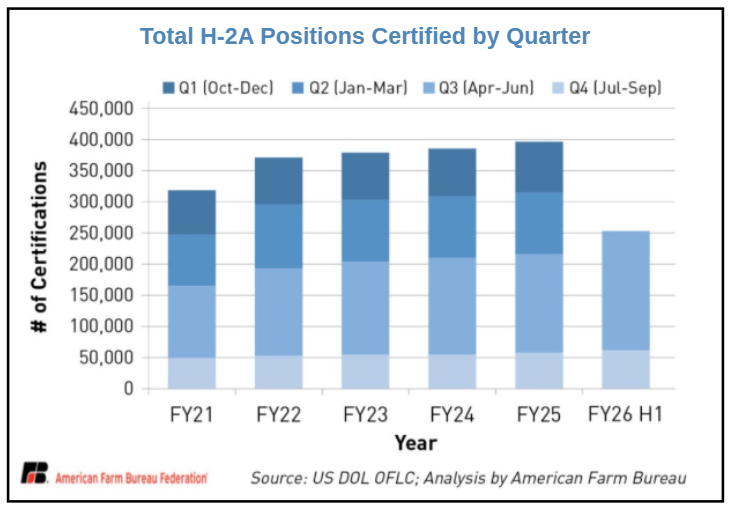
Key H-2A Program growth statistics
A recent article by an associate economist with the American Farm Bureau Federation (AFBF), Cameron Castillo, summarizes the growth highlights during the first half of fiscal year 2026:
H-2A Program job certifications reached 254,688 during the first half of fiscal year 2026
This translates to a 16.9% increase over the same period in fiscal year 2025, and a 19.2% above fiscal year 2024’s first half
Second-quarter certifications increased 20.5% compared with the same quarter in fiscal year 2025—the highest single-quarter jump on record
43 states expanded usage of the H-2A Visa Program during the first half of fiscal year 2026
Washington posted the largest increase among leading H-2A Program states at 67%, while Florida remained the largest overall user, already certifying 52.8% of its full fiscal year 2025 total
H-2A Visa Program certifications could approach 435,000 for fiscal year 2026 if current trends continue
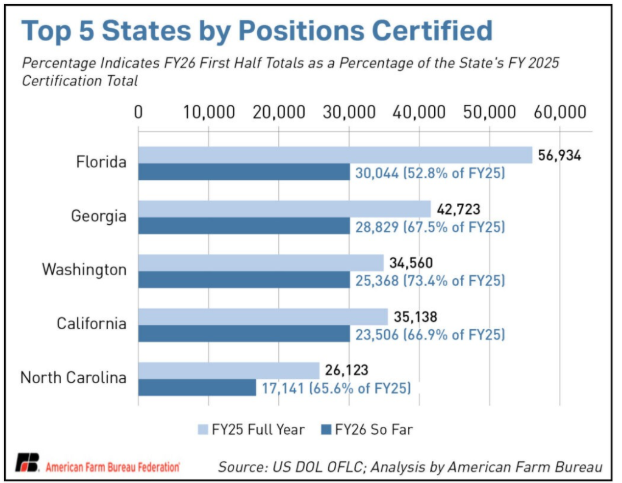
Key trends in H-2A Program usage
Growth in H-2A job certifications slowed in fiscal years 2023 and 2024, in part due to a costly 2023 disaggregation rule that required breaking job duties into separate applications and paying employees for jobs they might not always perform. This rule was vacated by a federal court in August 2025, leading to a significant increase in demand for H-2A Visa Program workers.
General projections and possible H-2A growth drivers
The U.S. Department of Labor projects demand for H-2A seasonal farm labor to surpass 500,000 by 2030, continuing a decade-long upward trend. It’s estimated that H-2A Visa Program workers will make up more than 20% of the total average U.S. employment by 2030, increasing from 15 - 18% currently.
The consensus across articles from AgDaily and other industry media is that the following factors are most likely responsible for the growth in the H-2A Visa Program:
Persistent domestic labor shortages due to steadily low unemployment (4.3% in May 2026)
A shrinking domestic farm workforce (only 182 of nearly 415,000 advertised seasonal farm labor positions in fiscal year 2025 were filled by domestic applicants)
Aging labor population
Stricter immigration enforcement
Nullification of the Department of Labor’s wage disaggregation rule, which had led to increased per-application costs
The DOL’s Interim Final Rule effective October 2025, which transitioned to a dual-tiered wage structure that includes an adjustment for the cost of housing and transportation, resulting in a decreased AEWR in most states
Efforts to streamline H-2A Program application rules and broaden job descriptions

H-2A Program growth insights from USA Farm Labor’s data
USA Farm Labor’s internal data shows that the long-term growth in H-2A Program participation is translating directly into significantly larger seasonal workforces. For example, USA Farm Labor facilitated approximately 1,325 worker placements in 2019 compared with 3,670 in 2025—an increase of roughly 177% in six years. Through the point measured in 2026, USA Farm Labor had already facilitated 3,529 placements, putting 2026 on pace to remain near historically high levels.
“What we’re seeing is a shift from employers viewing H-2A as a last resort for filling labor shortages to treating it as part of their long-term workforce strategy. Employers are planning earlier, retaining more of their proven workers from season to season, and using H-2A to create greater predictability in an agricultural labor market that has become increasingly unpredictable.”
— Jeff Amsler-Jendrzejczyk, USA Farm Labor
One of the more interesting trends we see is that growth is no longer simply about employers finding seasonal workers for positions they can’t fill domestically. The H-2A Visa Program is increasingly becoming a core workforce-planning strategy for ag employers. Participating H-2A employers are putting greater emphasis on retaining proven H-2A Program workers from one season to the next, supplementing returning H-2A workers with new recruits, and planning their labor needs much earlier.
USA Farm Labor’s Summer 2026 placement data illustrates that shift particularly well. Of approximately 3,563 workers, about 55% were returning H-2A Program workers, while the remainder of the workforce was filled through new placements from USA Farm Labor and our recruiting network. That tells us that employers aren’t simply using the H-2A Visa Program anymore—they’re becoming more sophisticated about building a repeatable seasonal agricultural workforce.
From USA Farm Labor’s perspective, several factors are converging at the same time to support the significant growth in H-2A Program participation:
Continued difficulty finding dependable domestic seasonal labor
Greater enforcement and uncertainty surrounding other sources of agricultural labor
Employers becoming increasingly familiar with the H-2A Program
At the same time, technology and process improvements have made it possible for organizations like USA Farm Labor to manage significantly greater application and worker volumes than would have been feasible several years ago.
Lean on USA Farm Labor’s expert team
Whether you need help identifying your top H-2 Program workers and facilitating their return, diversifying your agricultural workforce strategy, understanding H-2A trends, or you simply want a trusted partner by your side, USA Farm Labor can help.
