

It’s easy to take for granted that the food we eat just ‘shows up’ on grocery store shelves. But, for U.S. farmers and ag businesses that either use or are considering the H2A Visa Program, every step of this labor-intensive process is evident in their work-worn hands. And agriculture feeds our economy as well, generating more than $170 billion in yearly exports, according to the Niskanen Center, a political think tank.
The H2A Visa Program provides an essential safety net for American farmers that face an increasingly uphill battle to find the skilled labor they need to prepare, plant, harvest, transport, and process fruits, vegetables, and grains as well as breed, feed and care for livestock. This blog is designed to provide a summary of why the H2A Program was created, what the program is, the key benefits to farmers, and how it works.
The H2A Program fills a huge void for farmers
Aside from the weather, labor availability is one of the biggest factors that impacts farmers’ success, according to Robert Dickey, Chairman, GA House Ag Committee. The reality is, American workers don’t want to perform hands-on work for long hours in extreme temperatures for modest wages.
Labor shortages, especially during labor-intensive seasons such as peak harvest, began significantly increasing in the 2000s. And the problem is only getting worse given the aging farm workforce. Data from Market Intel shows that two trends—the increase in non-working college students and an aging U.S. population—are putting the squeeze on prime work age employees between 25 and 64. These trends are even more significant in rural farm areas where 20% of the population is over 65, compared to just 16% in urban areas. This has led to foreign labor becoming the main source of growth for the American workforce. “There’s just a smaller base so then they’re gonna have to rely on H-2A more and more," says Jeff Luckstead, a professor at Washington State University’s School of Economic Sciences.
Given the time-sensitive nature of harvesting, farmers' entire profits are at-risk when they don’t have sufficient experience or hands to do the work. And shifting gears isn’t an option. Chris Butts, Executive Vice President of the Georgia Fruit and Vegetable Growers Association sums it up when he says, “an acre of peppers is going to produce a lot more revenue than an acre of cotton does. So, it's not so easy to just say, ‘Hey, we're not going to do that. We'll just shift to something else that doesn't require the labor.’ You've got too much invested in that land and the infrastructure already."
The H2A Visa Program provides a lifeline
The H2A Program was launched in the 1950s in response to labor shortages as a result of war. The program was split into H2A (for ag) and H2B (for other seasonal businesses) in the mid ‘80s. While some row crops can be managed with modern machinery, there are still plenty of specialty crops that need human hands to grow and harvest. The H2A Program is vital to maintaining reliable farm labor while complying with immigration policies.
“Our growers over the years have tried everything to attract more domestic workers, but they're just not there. So the H2A Program really provides a lifeline to us. We see the program continuing to grow because that demand is there,” says Butts. Georgia is among the top two states using the H2A Visa Program and, according to Will Bentley of the Georgia Agribusiness Council, “Having a dependable labor force through the H2A program is really what makes Georgia agriculture successful in our ability to be diverse in the crops that we grow … we just simply couldn't do it if we weren't able to have a dependable labor force.”
Of course, it’s not just in Georgia, and it’s not just crop farmers that can’t find reliable, legal farm labor. Livestock farmers, beekeepers, nurseries, Farm Labor Contractors, and Custom Harvesters all face issues with finding dependable quality farm labor when they need it.

How does the H2A Visa Program benefit farms and ag businesses?
Aside from providing farmers and ag businesses with dependable, legal, and skilled farm labor, the H2A Program provides a whole host of other benefits for both H2A employers and workers. The H2A Visa Program helps farmers and ag businesses:
Avoid lost revenue—Having sufficient workers to harvest on time means minimal spoilage and waste.
Minimize risk—Adhering to all the H2A Program requirements can be overwhelming but it ensures your farm labor is here legally. Maintaining compliance helps you avoid costly fees and fines.
Save money—While participation in the H2A Visa Program requires a significant investment, it can actually save you money in the long run by eliminating the need to continually recruit and train new, inexperienced workers. According to Butts, Georgia growers would confirm that 90 - 95% of their workforce comes back year after year and becomes experienced. In addition, H2A workers are exempt from social security and Medicare taxes, lowering farmers’ labor cost.
Grow and expand—Having reliable, skilled labor frees up time to work on your business instead of in your business, allowing you to finally take advantage of new opportunities or expand into new markets. Read the impact that the H2A Program has made for one of our clients.
Reduce outsourcing—The skilled farm labor provided by the H2A Visa Program may allow you to bring tasks in-house that you previously had to hire a third party to do. See how the H2A Visa Program allowed the Schillings to eliminate expensive outsourcing.
Spend more time with family—Perhaps the most important benefit of the H2A Program is giving you some breathing room to finally spend some quality time with friends and family, knowing the farm is in good hands.
A win-win for H2A workers
The H2A Program benefits workers in big ways, too. They want to be here and provide for their families, and can make more than in their home country. It’s important to note that these workers do contribute to the U.S. economy, paying the same as domestic workers pay in taxes.
The H2A Visa Program continues to see exponential growth
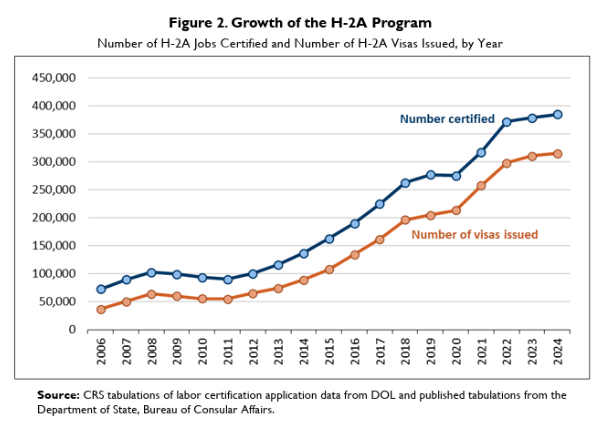
The H2A Program continues to grow, for good reason. According to the USDA, Economic Research Service, the number of employers requesting H2A workers has more than tripled between 2010 and 2024. H2A workers now account for 15% of employment on U.S. crop farms.
H2A employers generally fall into three categories:
Individual employers: Agribusinesses or fixed-site farms that directly employ H-2A workers and use their labor in-house
Growers associations: Groups that typically consist of multiple farms, frequently nonprofits, that promote the professional interests of their member farms
Farm Labor Contractors (FLCs): Agribusinesses that provide services to other farmers, such as pesticide or fertilizer spraying. Custom Harvesters are a specialized type of FLC.
So, what is the H2A Program?
The H2A Program is a government-mandated visa program that essentially fills the labor shortage gap by allowing farmers and ag businesses to legally hire foreign farm workers for temporary, seasonal jobs. The work must be agricultural in nature and performed on or for a farm. The program addresses the demand for reliable, skilled farm labor that often goes unfilled as a result of the lack of qualified, available domestic workers. According to the Farm Journal, in most cases, H2A workers make up 80 to 100% of the labor for their farm operation.
The H2A Visa Program is primarily designed to provide farmers and ag businesses with the extra hands they need during their primary peak season. However, it’s possible for farmers to submit multiple applications to provide help year-round, so long as the job descriptions and tasks defined in each application, say Summer vs. Winter, are unique. Year-round job tasks are not allowed under the H2A Program. While the program was initially focused on crop farmers, it has expanded over the years to also provide farm labor relief for livestock farmers, nurseries, beekeepers, Farm Labor Contractors, Custom Harvesters, and other types of agricultural businesses.
H2A workers legally come to the U.S. on an H2A visa as non-immigrant farm workers. H2A job orders, or contracts can be a maximum of 10 months. When a job contract is complete, workers have 30 days to be hired under a new job order or they have to return home. Conceivably, if you submitted both summer and winter applications, your same worker(s) could fulfill both. H2A workers can stay in the U.S. for a maximum of 3 years, and must return home at that point, staying in their home country for a minimum of 60 days before being able to return to the U.S. They must acquire a new non-immigrant H2A visa to return that will be valid for another 3 years.
How does the H2A Program work?
H2A employers must apply for a Temporary Labor Certification from the Department of Labor in order to hire H-2A workers. Workers must get an H2A non-immigrant work visa to come over to the U.S. as H2A workers. The entire process takes roughly 90 days and involves working with three government bodies.
The Department of Labor (DOL) enforces the rules and may approve or deny your applications for certification. If approved, the DOL issues your Temporary Labor Certification. Your state’s government-run employment agency (SWA) screens your job order and application before it’s sent to the DOL, inspects your worker housing, and sends domestic candidates to you for consideration. The U.S. Citizenship and Immigration Services (USCIS) issues work visa permits to consulates that grant the worker visas. H2A employers must satisfy specific eligibility requirements as well as make specific provisions for their H2A workers.
Learn more about H2A Program and worker requirements
Compliance is critical
The H2A Visa Program is complex. The paperwork alone can put fear in even the most confident farmer. In-depth understanding of and compliance with the myriad of rules and regulations is essential to avoid costly fees and fines and ensure the ability to continue using the program—not to mention getting your application approved. It’s important to note that an approved Temporary Labor Certification in-hand does not automatically guarantee the necessary work visas will be issued. According to the American Immigration Council, only 80% of jobs certified as H2A result in visas, leaving 20% where no visas are issued.
For these reasons, many farmers and ag businesses choose to use an agency, like USA Farm Labor, to navigate the overwhelming process for them. USA Farm Labor simplifies and streamlines the H2A process, and boasts a 99.9% approval rate, so you can focus on growing your farm or ag business. We put 6,000-plus vetted, skilled workers at your fingertips in our proprietary database thanks to our global network of recruiters. You can lean on our dedicated USCIS department to assist with visa petitions, as well as our Strategic Compliance Alliance to identify and eliminate any potential vulnerabilities in the event of an audit.
Learn more about the advantages of using USA Farm Labor
We’re here to help
Whether you’re new to the H2A Visa Program, have participated in the program but have still had trouble finding quality farm workers, or your current agency isn’t meeting your needs—let’s talk. We’ll take the time to get to know your business, your specific needs, and your biggest challenges to see if the H2A Visa Program is a good fit and how we can help you make the most of the program. Reliable, quality farm labor is just a call away.
