

The H-2A Visa Program helps U.S. farms and ag operations by providing reliable, skilled farm workers to fill their agricultural labor gap. While most ag businesses need seasonal farm labor for the typical farm tasks, such as pruning, cultivating, and harvesting—they also need workers to perform more advanced tasks, such as operating agricultural equipment or driving tractor-trailers.
USA Farm Labor fields a lot of questions about driving skills and the associated licensing and H-2A compliance requirements. This blog is intended to educate farms and ag operations on the various types of farm driving jobs, licensing requirements, how driving skills impact compensation, how to properly disclose driving on the ETA-790/790A, and common mistakes to avoid.
Types of farm driving tasks
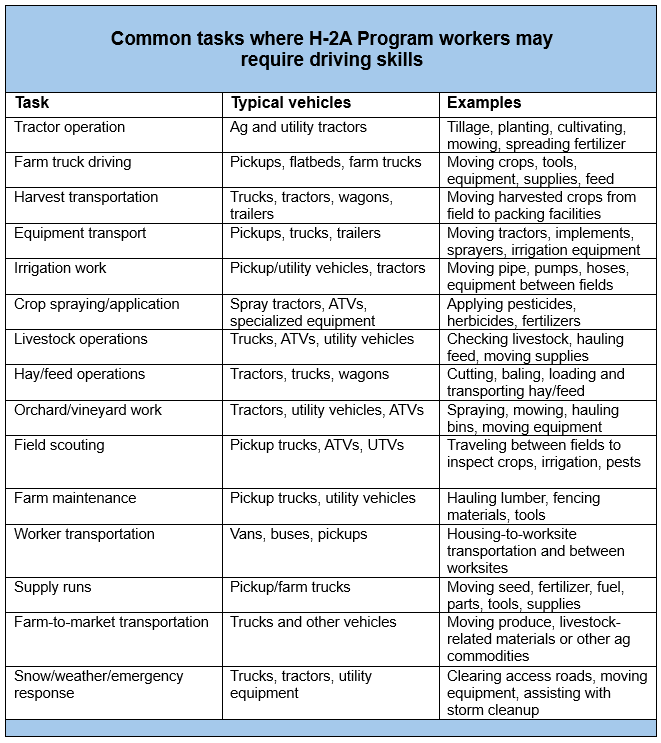
For an ag operation participating in the H-2A Program, driving skills can go way beyond simply transporting workers. Depending on the farm, driving may be part of field production, equipment operation, logistics, livestock care, or worker transportation.
Biggest mistakes ag operations make when determining driving requirements
Not identifying all the requirements before the Job Order is submitted
Too many ag operations participating in the H-2A Program treat driving as incidental, so they fail to assess the needs prior to submission and don’t disclose the details on the ETA-790A. They mistakenly think just because the worker will only drive occasionally that they don’t need to list it. While frequency is one consideration, things like type of vehicle, whether the worker will be transporting other workers or crops, if additional pay is involved, and if there are special licensing requirements, such as a Commercial Driver's License (CDL), also impact whether or not the driving tasks must be disclosed.
Here are some other common mistakes ag businesses make related to H-2A Program driving requirements:
Being too general
In most cases, you’ll want to avoid simply stating:
"Must have driving experience."
Be sure to use more specific language on your ETA-790A, so it’s clear what type of driving the workers will be doing, what types of vehicles or equipment are involved, and what licensing is required.
For example:
"Experience operating agricultural tractors."
"Experience operating farm trucks and hauling agricultural products."
"Experience operating tractors, sprayers and other agricultural equipment."
"Experience driving pickup trucks and transporting farm equipment and supplies."
"Experience hauling crops from fields to packing facilities."
"Valid driver's license required for operation of farm vehicles."
"CDL required for operation of vehicles requiring a CDL."
Confusing a driver’s license with a CDL
It’s a common misconception that stating, "Must have a valid driver's license.", on your ETA-790A is sufficient. That doesn't necessarily mean the worker is qualified to operate every vehicle your farm owns. A regular state driver's license may be sufficient for some of your farm vehicles. A CDL may be required for others. And a CDL may require an endorsement depending on the type of vehicle and use. We talk more about endorsements in a later section.
Assuming if your farm is eligible for the Farm-Vehicle Exemption you don’t need to disclose driving requirements on your ETA-790A
The fact that your farm may qualify for a Farm-Vehicle CDL exemption doesn't mean you should omit driving from the ETA-790A. The exemption only addresses the driver's license requirement, not the H-2A rules and regulations that require you to accurately describe the job opportunity.
Not realizing there’s a difference between driving crops and driving workers
It’s important to know that driving workers is different from driving agricultural products. According to H-2A rules and regulations, workers tasked with using employer-provided transportation to drive workers to and from worksites and housing must have a valid driver’s license recognized by the state where they’re driving. Where a CDL is required for a particular vehicle, the driver must have a valid CDL.
For example:
Scenario A — Worker drives a tractor
An H-2A Program worker operates a tractor as part of normal farm operations.
That's a farm-equipment/field-operation issue.
Scenario B — Worker drives a truck carrying harvested crops
That's transportation of an agricultural commodity and may implicate commercial-driver rules depending on the vehicle and operation.
Scenario C — Worker drives a bus/van carrying 20 H-2A Program workers
Now you're dealing with passenger transportation, which can create substantially different CDL and safety requirements.
Scenario D — Worker drives the crew van from housing to the farm
This is both an H-2A transportation obligation and a driver-qualification issue. DOL requires you to provide daily transportation between your provided housing and the worksite at no cost, and vehicles used to transport workers must meet applicable federal, state and local safety requirements and be properly insured. Drivers must possess a valid license recognized by the state where they are driving.
Special qualification and licensing requirements
You may be eligible for the Farm-Vehicle Exemption
The Federal Motor Carrier Safety Administration (FMCSA) allows states to exempt certain farm vehicle drivers from CDL requirements, specifically if a farm vehicle is:
Controlled and operated by a farmer
Used to transport agricultural products, farm machinery or farm supplies to/from a farm
Not operated as a for-hire motor carrier
Operated within 150 air miles of the farm
The Farm-Vehicle Exemption isn’t automatic simply because you're a farm. You’ll need to determine whether your state actually provides the exemption and whether your particular operation satisfies its requirements.
What is a CDL?
A CDL is a type of truck driving license in the U.S. We cover the various types below.
How to know if a CDL is required
Driving tasks don’t automatically mean that the worker requires a CDL. The answer depends on:
The vehicle
How it’s being used
Number of passengers
Weight ratings
If hazardous materials are involved
Applicable federal/state exemptions
Different types of CDLs
First, here are a few important definitions:
GVWR = Gross Vehicle Weight Rating, the maximum safe loaded weight including the vehicle, passengers, fuel, and cargo
GCWR = Gross Combination Weight Rating, the maximum total weight of a combination vehicle including the towing unit, trailer/s, occupants, and cargo
GVW = Actual weight on a scale including cargo, fuel, and passengers
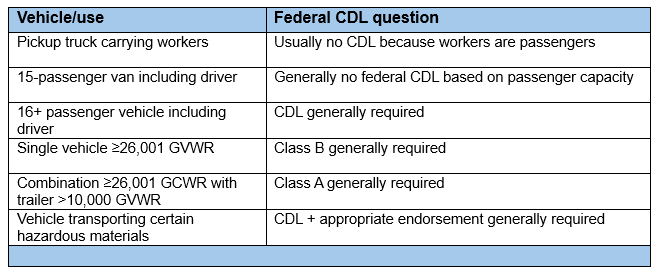
Federal CDL classifications include:
Class A: for driving semi-trucks with trailers attached, including flatbeds and livestock carriers, GCWR/GVW of 26,001+ pounds, towing 10,000+ lbs.
Class B: for driving straight trucks, such as dump trucks and buses, GVWR/GVW of 26,001+ pounds, towing 10,000 lbs. or less
Class C: for driving smaller, lighter vehicles carrying 16+ passengers (including driver) or transporting hazardous materials
So, for example:
What is an endorsement?
Certain specialized commercial driving requires an additional endorsement on the CDL. These endorsements involve additional testing/qualification beyond the underlying CDL. The actual legal requirement depends on the vehicle and how it’s being operated. States can also have additional CDL categories, endorsements, or restrictions.
FMCSA currently identifies these principal endorsements:
Endorsement What it generally permits
P Passenger vehicles
N Tank vehicles
H Hazardous materials
X Tank + hazardous materials
T Double/triple trailers
S School buses
Here are a few examples of how CDLs and endorsements might show up on an ETA-790A:
“Need an H-2A worker to drive a farm bus transporting other workers. Valid CDL with required passenger endorsement required.”
“Need a worker to drive a tanker. CDL with required tank vehicle endorsement.”
“Need a worker to haul qualifying hazardous materials. CDL with required hazardous-materials endorsement.”
“Need a worker to pull double/triple trailers. CDL with required T endorsement.”
Driving licensing requirements simplified
Don’t assume driving an "agricultural vehicle" automatically means "no CDL." Federal CDL rules depend on the vehicle, its weight/configuration, what it’s transporting, where it’s operated, and whether a Farm-Vehicle Exemption applies. States can also have additional exemptions or requirements.
USA Farm Labor recommends dividing driving requirements into four categories before starting the H-2A application process:
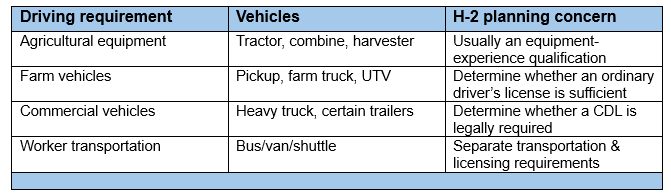
Use the following framework to identify the specific licensing requirements:
Category 1 — No driver's license normally required
Examples:
Tractor
Combine
Harvester
Sprayer
Mower
Irrigation equipment
ATV/UTV on private farm property
Suggested Job Order language:
"Experience operating agricultural tractors and farm equipment preferred."
Category 2 — Regular driver's license
Examples potentially include:
Pickup
Small farm truck
Certain utility vehicles
Some smaller worker transportation vehicles
Suggested Job Order language:
"Valid driver's license required to operate farm vehicles."
Remember to verify the vehicle and applicable state requirements.
Category 3 — CDL may be required
Examples:
Heavy farm truck
Grain truck
Large truck/trailer combination
Certain livestock trucks
Certain feed trucks
Certain tanker operations
Remember to evaluate the vehicle weight, configuration, agricultural exemption, and state law.
Category 4 — CDL and/or endorsement clearly implicated
Examples:
Semi/tractor-trailer → typically Class A
Large passenger vehicle → potentially CDL + P
Tank vehicle → potentially N
Hazardous materials → potentially H
Tank + hazardous materials → potentially X
Double/triple trailers → T
USA Farm Labor recommends the following process to identify licensing requirements:
Vehicle → vehicle classification → type of operation → CDL class → endorsement/other qualification
How driving tasks and CDL requirements impact the H-2A process
A CDL requirement can significantly affect the H-2A Program process. You’re no longer simply looking for ag labor—you’re specifying a regulated qualification that a worker must possess to perform certain duties legally.
The CDL requirement needs to be disclosed in the H-2A Job Order
If you know that an H-2A Program worker will be required to operate a vehicle for which state or federal law requires a CDL, that qualification should be accurately reflected in the ETA-790/790A for two reasons. You shouldn’t hire H-2A Program workers expecting them to perform a significant CDL-required duty that wasn't properly disclosed. And the Job Order becomes part of the material terms and conditions of employment.
For example:
"Workers will operate farm trucks requiring a valid commercial driver's license (CDL)."
is substantially different from:
"Workers may occasionally drive farm vehicles."
CDLs can impact the recruitment process
A CDL requirement potentially narrows the pool of qualified applicants.
For example:
"General Farm Worker — CDL required"
is likely to have a smaller applicant pool than one seeking:
"General Farm Worker — tractor/farm equipment experience preferred."
The qualification needs to be genuinely necessary for the job and consistently applied.
For recruiting H-2A Program workers, it helps to define driving requirements across these five categories:
1. Agricultural equipment operation
Tractor
Combine
Harvester
Sprayer
Mower
Specialized harvesting equipment
2. Farm vehicle operation
Pickup
Flatbed
Farm truck
ATV/UTV
Utility vehicle
3. Hauling
Crop loads
Equipment
Feed
Fertilizer
Irrigation equipment
Tools and supplies
Trailers
4. Worker transportation
Van
Bus
Other passenger vehicles
5. Specialized/commercial driving
Dump truck
Semi
Tractor-trailer
Other heavier vehicles
A worker having experience driving trucks in another country doesn’t necessarily mean the worker has a U.S.-valid CDL. You must distinguish between:
Experience
Has driven trucks
Has hauled agricultural products
Has operated tractors
Has driven buses
Legal qualification
Possesses the required U.S. driver's license
Possesses the required CDL class
Has required endorsements
Meets applicable state requirements
CDL requirements can impact timing
The H-2A Visa Program process involves the Job Order, recruitment, Temporary Labor Certification and the worker's immigration process. ETA-790/790s should be filed 75 – 60 days before the first date of need. If you realize after submission that you need a few of the workers to have a CDL, it can create inconsistencies between the job that was certified and your actual need. This may also lead to delays in the immigration process.
CDL requirements may impact compensation
If you plan to provide additional compensation for driving duties, the DOL requires that you specify the special duty, wage rate, and additional compensation on your ETA-790A.
For example:
Farm laborer — $X/hour
Additional $X/hour when assigned driving duties
How and when to specify driving tasks and CDLs on the H-2A Job Order
The time to determine the driving and licensing requirements for your H-2A Program workers is before you file the ETA-790A—not after the worker arrives—because the driving requirement can affect the job description, U.S. worker recruitment, worker qualifications, wage disclosures, transportation compliance and your ability to actually assign the worker to that duty. If you expect an H-2A worker will have to drive as part of the job, the specific driving tasks and other essential details should be disclosed on the ETA-790A. The ETA-790A specifically has a section for "Driver requirements" and "Certification/license requirements" under minimum job qualifications/requirements.
If the job genuinely requires a CDL, you should treat the CDL as a job qualification.
For example:
"Must possess a valid Class B CDL with passenger endorsement"
rather than:
"Farm laborer", then telling the H-2A worker after arrival he/she will need a CDL to drive the bus.
One more ETA-790/790A consideration
The Job Order should describe the actual position being offered—not create a blanket qualification that doesn't apply to every worker.
For example, say your need is:
"10 general farm workers, but 2 of them need to drive the grain truck."
Consider whether the driving qualification should be identified as a specific job requirement/duty rather than simply attaching "CDL required" to all 10 positions. Likewise, if only one or two workers will transport the crew, don't necessarily make every H-2A worker a CDL-qualified driver.
“Preferred” vs. “Required”
There’s a difference between specifying "CDL preferred" if it’s actually required.
If the worker must legally possess a CDL to perform a particular duty, you should disclose that.
Conversely, if the worker can perform the job without a CDL and you simply consider CDL experience advantageous, "preferred" may be appropriate.
A practical process to identify driving and licensing requirements
USA Farm Labor recommends following this process to determine what belongs in the ETA-790A minimum qualifications/requirements:
Step 1: Will H-2A workers drive?
No → No special driving disclosure needed
Yes → Continue
Step 2: What will they drive?
Vehicle type
GVWR
GCWR
Passenger capacity
Trailer
Intended use
Whether transporting workers, products, equipment or supplies
Step 3: Is a CDL required?
Check:
Federal CDL requirements
Applicable state law
Agricultural/Farm-Vehicle Exemptions
Required endorsements
Any interstate/intrastate implications
Step 4: Is driving a real job responsibility?
If yes, include the driving duty in the ETA-790A
Step 5: Are special qualifications required?
Examples:
Valid driver's license
CDL
Class A/B/C
Passenger endorsement
Clean driving record
Minimum driving experience
All job requirements need to be properly disclosed and applied consistently.
Step 6: Is additional compensation provided?
If yes, disclose the driving duty and additional compensation in the Job Order.
Lean on USA Farm Labor’s experts
USA Farm Labor specializes in providing U.S. ag businesses with skilled H-2A Program workers, such as Ag Equipment Operators. So our experienced team knows how to structure and word your ETA-790s to make sure you get workers with the right skills and experience. Plus we make sure you follow all the H-2A rules and regulations and maintain H-2A compliance.
