
The state of agricultural labor in America has been a hot topic on Capitol Hill over the past couple of years. From the introduction of the Saving Agriculture’s Workforce Act (SAWA) to ongoing court cases over wage rates and the methods used to determine those rates, the topic of agricultural labor and farm workforces has been top of discussion.
What will the H-2A workforce look like in 2027?
Using a combination of public data from the Department of Labor (DOL), United States Department of Agriculture (USDA), and USA Farm Labor’s proprietary, in-depth summer 2026 worker placement analysis, today’s blog takes a look at 8 H-2A workforce trends going into 2027 to help you better prepare your farm or ag business for the upcoming season.
1. Labor availability will make H-2A Program planning even more important
The availability and long-term supply of farm labor are changing. The USDA reports a shift in farm workers settling geographically instead of “following the crops,” or migrating from farm to farm for available seasonal crop work. Likewise, the average age of migrant farmworkers is rising while fewer young workers enter the ag workforce.
So, H-2A workers and domestic farmworkers are more settled and getting older. As more workers leave the ag workforce or retire, the Bureau of Labor Statistics (BLS) predicts more annual job openings.
What this means for farms in 2027:
Determine your labor strategy months ahead of time; don’t wait
Forecast your labor needs by crop, task, date, and skill
Identify the jobs that are hard to fill (highly skilled positions)
Develop primary and backup labor sources
Check out our guide on how many H-2A workers you should request
2. A diverse labor strategy helps farms prepare for uncertainty
Employers who put all of their hiring focus into either H-2A workers or domestics might encounter labor shortages or issues at some point. The latest trend in farm workforce planning is to develop a diverse labor strategy consisting of a combination of:
Returning H-2A workers (unless you’re just getting started with H-2A)
New H-2A workers
Domestic workers (returning and new)
Eligible workers already in the United States (in-country H-2A workers)
One of the best things you can do is have a contingency plan for your seasonal farm workforce. Likewise, you might want to consider:
Cross-training your best workers to handle multiple tasks
Equipment upgrades
Utilizing mechanization for appropriate tasks
You’ll want to continue developing and perfecting your labor strategy to ensure you have the labor you need when you need it most.
Learn more about the benefits of partnering with the right H-2A agency
3. The H-2A Visa Program will continue to be an important part of America’s ag workforce
The increased use of the H-2A Program can’t be ignored. According to the USDA’s farm economic research report, the number of H-2A positions requested and approved has increased more than sevenfold in the past 19 years, from just over 48,000 positions certified in fiscal year (FY) 2005 to around 385,000 in FY 2024. So far, FY2026 DOL data shows significant use of the H-2A Visa Program for crops, livestock, and equipment operator roles (see the chart below).
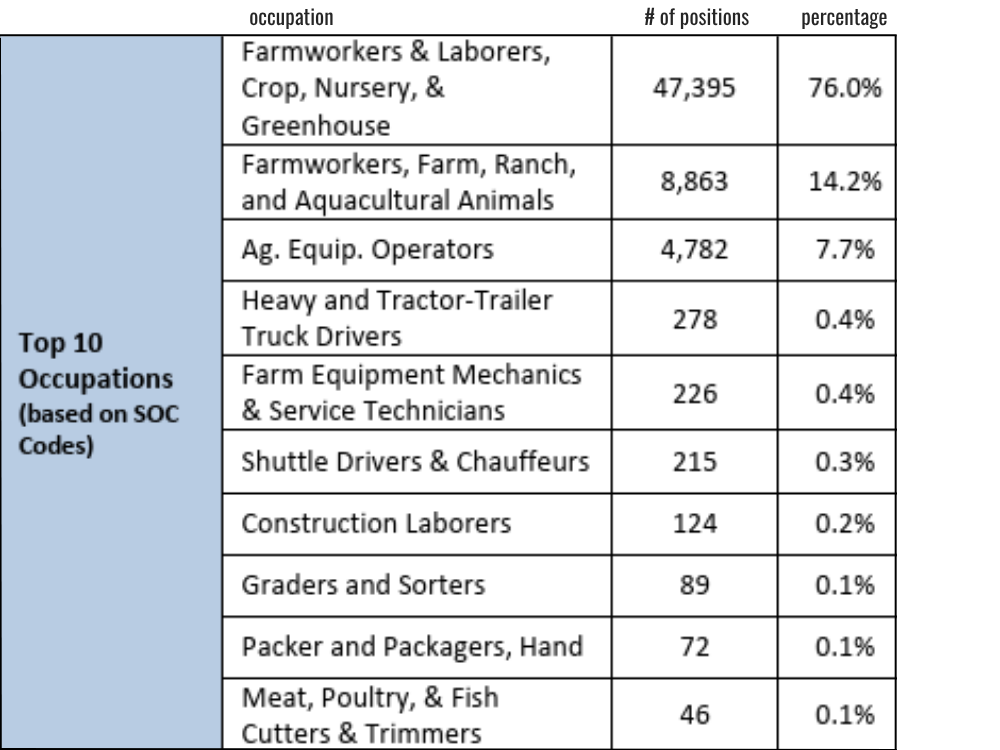
For 2027, farms that depend on seasonal labor should increasingly think of H-2A as a workforce planning system, rather than simply an emergency source of workers.
That means strategic planning around:
Application timelines
Anticipated headcount
Returning workers
Recruitment
Housing
Transportation
Onboarding
Productivity
Retention
Compliance
Contingency labor
Learn more about what’s behind the skyrocketing participation in the H-2A Program
4. Cost of H-2A labor and wage uncertainty will require more careful budgeting
H-2A Program employers pay an H-2A minimum wage, known as the Adverse Effect Wage Rate (AEWR). The DOL is responsible for setting those wages on an annual basis, but a recent lawsuit against the DOL has created uncertainty for 2027.
Despite the lack of clarity surrounding wage rates, farms or ag businesses using H-2A workers need to factor in the total cost of employing these seasonal employees, not just wages. It’s critical to also factor in:
Housing
Transportation
Recruitment
Administrative costs (application paperwork, government fees)
Compliance costs (recordkeeping, software costs)
Potential overtime/productivity implications (some states have overtime requirements even for H-2A/ag employees)
5. H-2A farmworker retention will be as valuable as recruitment
So far, we’ve established the current ag workforce is moving less with the crops, aging, and that farmers and ag businesses are increasingly using the H-2A Program to source seasonal farmworkers. As a result, retaining your skilled, valuable seasonal workers is increasingly important.
If you have a worker who:
Knows your crops
Is trained to understand your operation and job expectations
Knows your equipment
Requires less retraining or hands-on daily management/supervision
That worker is exponentially more valuable than a new hire. Instead of just asking, “how many workers did we get?” ask, “how many workers are returning and how effective are those workers for my jobs?”
Check out client-proven strategies for increasing H-2A worker retention
6. Matching H-2A workers to the right jobs matters
As agriculture moves more toward the H-2A Program for sourcing seasonal farm labor and emphasizes retention, accurately matching employers and workers will matter that much more. This is also where choosing the right H-2A agency and recruitment partners comes into play.
Your H-2A agent and recruiters need to focus on:
Accurate skills verification, especially for equipment operators and jobs that require specialized experience
Helping you narrow down and define your H-2A job requirements before recruitment begins
Filtering out and vetting overstated resumes, inaccurate equipment experience, and mismatched expectations (from both perspectives; workers and employers)
Our USA Farm Labor data supports this trend as well. According to the USA Farm Labor placement analysis, our clients have experienced a 3.3% drop-off in what we consider “adverse” terminations, meaning a worker was fired or quit on bad terms. Likewise, only 1.7% of those adverse terminations were due to skills or experience mismatches.
While there is no single reason for this drop, our agency’s focus is on vetting, skills verification, and properly screening H-2A workers before making them available to our clients.
Learn more about how to define skills, duties, and qualifications for your H-2A workforce
7. Productivity and specialized skills will remain important
Recruiting and retaining your best seasonal H-2A workers will become a more common workforce strategy for ag employers in the coming years. But worker productivity and specialized skills will remain just as important. The question isn’t only how many H-2A workers you need, but what those employees can accomplish and contribute.
Farmers and ag operations increasingly need workers with specialized skills such as:
Truck and ag equipment operation
Mechanical, maintenance, and repair
Irrigation
Precision ag and technology (GPS, autosteer, drones)
Ag employers should consider how training, supervision, and equipment upgrades or mechanization can help improve productivity for their H-2A workforce. It’s not just about recruiting and hiring skilled workers; you also have to put them in a position to succeed.
8. H-2A Program compliance and H-2A workforce management need year-round attention
Compliance with the rules and regulations of the H-2A Program extends far beyond submitting a compliant Job Order application. Employers must:
Keep accurate payroll, reimbursement, and domestic recruitment records
Ensure you’re paying the correct wage rates
Keep up with H-2A Program updates and rulemaking
Compliance with the rules of the H-2A Program should be part of your larger workforce management strategy, even if you’re utilizing a large domestic workforce.
Successful H-2A employers use the off-season to review processes, organize critical compliance records, address gaps, and ensure their seasonal H-2A workforce will meet next year’s needs.
Read more about year-round planning for success with the H-2A Program
Build your 2027 workforce plan with USA Farm Labor
As the 2027 farm season approaches, it’s vital to get your workforce planned and established. The changing landscape of farm labor makes planning, recruitment, and retention so much more important than in years past. It also makes choosing the right H-2A agency to partner with a critical decision that can impact your business in 2027 and beyond.
USA Farm Labor has been putting our farmer clients in a position to succeed for more than 20 years, and our placement stats back that.
You’ll also get access to helpful H-2A management tools such as our H-2A compliant pay slip templates, dedicated worker placement coordinators, and our Strategic Compliance Alliance for help with legal, payroll, bookkeeping, and compliant H-2A audit-ready recordkeeping.