How Many H-2A Workers Should You Request?
Accurate planning and forecasting are essential when you’re using the H-2A Program for seasonal farm labor. But determining the number of H-2A workers you need isn’t always as straightforward as planning crops, choosing equipment, or forecasting harvest schedules.
Today’s blog breaks down how many workers H-2A Program employers should request and offers a few tips for forecasting those critical business decisions.
Start with assessing your farming operation
Building a seasonal H-2A workforce for your operation starts with taking a deep dive into your farm business and daily operations. First-time H-2A ag employers should first look at areas like:
Acreage farmed
Types of crops or livestock
Planting schedules
Harvest schedules
Types of equipment being used
Number of labor hours that need to be filled (daily/weekly/monthly/sesonal projections)
Types of seasonal tasks that need to be done (i.e., spraying, irrigating, tilling, baling)
Field locations or multiple worksites
All of these factors will go into determining how many H-2A workers you need for your farm. Remember, you’re making a labor forecast months before you actually need the workers, so you’ll want to plan beyond a number that “sounds about right,” and make an informed workforce decision.
Use previous growing seasons as a starting point for determining H-2A labor
Take a look back at previous seasons before making an H-2A labor forecast by asking questions such as:
Did I have an accurate number of workers in previous seasons?
Was that enough labor to get everything done on time?
Were my crews still overwhelmed with the amount of work?
Did we have to scramble to find extra domestic labor last minute?
Was harvest completed on time?
Did we maximize harvest yields?
Were there problems created by a lack of labor?
Were there certain times of the year when additional labor could have helped us avoid those problems?
Sit down and take stock of previous seasons before planning your workforce needs. The H-2A Program is essential for ag employers like yourself to have the labor you need when you need it most, and answering these questions above will help you determine the times of year you need additional help. From there, consider the following questions before moving forward:

Evaluate what has changed or is changing in your farming operation
Farms need to evolve to keep up with demand, meet quotas, and stay in business growing America’s food supply. Operational changes will drive workforce needs. Factor in evolving farm operations:
Are you farming different, more labor-intensive crops?
Did you lose one of your domestic workers and need to fill that void?
Are you implementing new growing methods now or in the future?
Did you take on more acreage or plan to downsize now or in the future?
Did commodity prices change your financial projections?
Many of our clients at USA Farm Labor come to us with these exact scenarios. Kids go off to college, domestic workers move on to other jobs, crops are rotated, equipment is upgraded, new growing methods or technologies emerge, acreage grows or decreases, and labor needs simply change over time.
What types of skills or knowledge do you need from your H-2A workers?
Think of your ideal seasonal farmworker to determine the skills you need most from your H-2A employees. Assess needed skills or areas of expertise such as:
Operating farm equipment
Driving trucks
Maintaining farm structures or equipment
Working with livestock
Performing crop or livestock health assessments
Read more about H-2A job orders and worker duties
H-2A compliance requirements’ role in how many H-2A workers you should request
H-2A employers have many different compliance requirements that can impact the number of workers you request. Effectively managing compliance requirements and the costs associated with those requirements is one of the keys to getting the most out of the H-2A Visa Program to support your business.
The number of workers you should request will somewhat depend on your ability to fulfill your H-2A compliance requirements such as:
The ¾ guarantee (fulfilling three-fourths of the job contract’s offered hours)
Employer-provided housing and transportation costs and availability
Adverse effect wage rates (H-2A minimum wage rules)
These compliance factors are critical to consider because they are also tied to your financial resources and overhead. Areas such as wages, fulfilling contract hours, and providing housing and transportation should all be carefully considered before settling on the number of H-2A workers you want to request.
USA Farm Labor’s tips for building an accurate H-2A labor forecast
It’s critical to be granular when determining how many seasonal H-2A workers to request. Dig into the daily scope of work and tasks you need your workers to perform. Here’s a short framework you can use as an H-2A labor planning tool:
Step 1: Identify each major seasonal task and the time it takes
Step 2: Estimate how much work needs to be completed
Step 3: Determine how many workers each task requires
Step 4: Identify required skills
Step 5: Account for your existing U.S. workforce, including yourself
Step 6: Compare needs against previous seasons
Step 7: Build in reasonable expectations for peak workload
Step 8: Review the number with your H-2A agency to ensure you can meet all compliance requirements before filing
Here’s also a quick resource to help you map your needs and ensure accurate H-2A workforce planning:
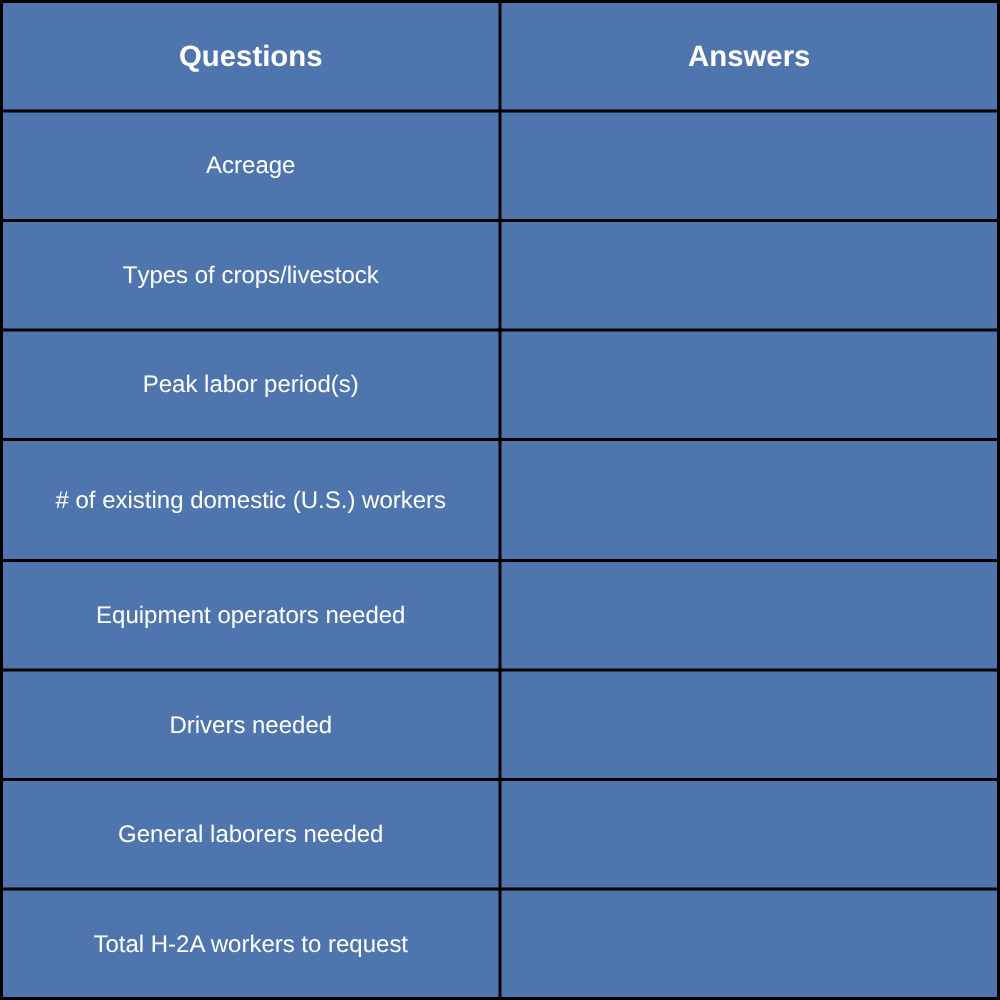
At USA Farm Labor, we advise you to make your best “good faith” estimate of how many seasonal H-2A workers you request using the factors outlined above as a basis for your decision.
Examine your operation, consider the cost of employing H-2A workers, and assess your ability to meet various compliance requirements before settling on the number of workers you actually need.
Using our own company data from new client consultations, we’ve put together some of the most frequently asked questions our team gets regarding the number of H-2A workers to request.
What happens if you request too few H-2A workers?
If you request too few H-2A workers, you’re going to be in the same situation you were in when you first chose to pursue using the H-2A Program to source seasonal farm labor. Too few workers means:
Existing employees will have to take on more tasks
Bottlenecks during peak loads
Planting and harvest schedules can get disrupted
Scrambling for workers last minute (again)
Obviously, the goal is to have the seasonal labor you need when you need it most, so underestimating the number of workers you need can be catastrophic for your farm season.
What happens if you request too many H-2A workers?
Likewise, requesting too many H-2A workers than you can accommodate means:
Not enough hours to fulfill key H-2A compliance requirements (¾ guarantee for hours and wages)
Total labor costs increase
Housing, transportation, protective gear, and other H-2A overhead costs are higher; profits are lower
Supervising and managing your H-2A employees can become a challenge
Workers without enough hours may become disgruntled, leading to retention issues
Can you change the number of workers you need later?
Unfortunately, no, you cannot change the number of workers you need later. Once you file your Job Order requesting a certain number of H-2A workers with the State Workforce Agency and Department of Labor (DOL), you can’t amend the number. However, as of the writing of this blog article, staggered entry for seasonal H-2A workers is allowed. Staggered entry offers H-2A employers greater flexibility in workforce planning and meeting seasonal labor needs at different times of the year.
Here’s an example to help you visualize what staggered entry looks like for the H-2A Program:
Let’s say you need a couple of workers for planting season, but will need to increase your workforce for harvest. Staggered entry allows you to bring additional workers at different times of year to meet those increased workload needs. You can bring a couple of workers over for planting, and bring additional workers over for harvest to help supplement your seasonal crew.
What if you need to fire an H-2A worker or a worker quits? Can you get a replacement?
The short answer is yes, you can get a replacement worker should you need to fire an H-2A employee or one quits mid-season. Without getting too deep into the H-2A process here, your certified Job Order is tied to your USCIS I-129 petition for temporary nonimmigrant workers.
The USCIS petition is for a certain number of unnamed workers, and you fill those names when hiring and making job offers. If one of those workers quits or gets fired, you have an open “slot” or job to fill on your I-129 petition. That’s not to say the process of replacing a worker is fast or easy, but having an experienced agent like USA Farm Labor will help when issues like this arise.
USA Farm Labor helps you secure the H-2A workers you need when you need them most
One of the biggest mistakes new H-2A employers make is waiting until the last minute to plan their workforce needs. USA Farm Labor does more than file some paperwork with the government and hope for the best. Our end-to-end H-2A services help you effectively plan to use the Program in a way that benefits your ag business, accurately forecast the number of workers you need for your farm, and our Worker Placement Coordinators support both you and your workers throughout your season so you’re all in the best position to succeed.