
Hiring H-2A workers is a significant investment of time, energy, and financial resources for any agricultural operation. We’ve already discussed some of the total costs associated with using H-2A for seasonal labor, but one of the biggest mistakes employers make is budgeting only for the cost of workers and not the cost of the Program itself.
Unexpected expenses can put pressure on your operation's finances, especially during a demanding growing or harvesting season. Successful H-2A workforce planning starts with understanding the full financial commitment before you submit an H-2A Job Order. Simply put, planning and forecasting are essential for a successful and profitable farm season, and that includes the full cost of your labor solutions.
But sometimes, to get the most out of the H-2A Program, it’s better to know what not to do, instead of focusing on hard-line budget strategies.
To help you understand the full scope of the financial commitment, today’s blog covers some of the biggest mistakes that farm and agricultural employers make when budgeting for the H-2A Program.
1. Not budgeting for the total cost of the H-2A Program
One of the biggest mistakes you can make when planning your finances for the H-2A Program is not considering the full cost of using the Program. As an employer preparing to use H-2A, you should take into account the following expenses:
Various H-2A government fees
Department of Labor (DOL) Certification fees ($100 +$10 per worker requested; currently suspended since October 2025 until an electronic payment system can be established)
United States Citizenship and Immigration Services (USCIS) petitions (varies based on the size of your business and number of full-time regular employees)
Applicable migrant housing permit fees (only in some states such as Texas and Florida)
H-2A agency fees
Application/Job Order preparation fees
Recruiter and worker fees
Licensing or Farm Labor Contractor (FLC) fees
H-2A Program costs
Employer-provided housing
Employer-provided transportation:
Daily (to and from the worksite)
Inbound (from home country to your farm)
Outbound (from your farm back to their home country)
Consulate fees (small but add up if you’re requesting several H-2A workers)
Subsistence and reimbursement costs (meals and lodging while your H-2A workers are traveling; capped at $68 per day with receipts)
H-2A worker wages and applicable overtime
Required Workers’ Compensation policy (if you don’t already have one)
Required surety bonds (for FLCs and Custom Harvesters)
Contingency costs
Housing maintenance, repairs, or improvements to pass inspection
Daily transportation repairs and maintenance
Utilities, fuel, tools, and equipment
Read our detailed breakdown of H-2A Visa Program costs
2. Failing to view H-2A workers as an investment
Regardless of the type of business or industry you’re in, it’s critical to view your workforce as an investment, not a cost. Your seasonal H-2A workers are no different. You’re investing in your H-2A workforce and in the Program itself, including areas such as:
Housing: H-2A housing is one of the biggest investments, especially if you don’t already have farmworker housing in place. While it’s a large investment, your H-2A housing can be used season after season, for the duration of using the Program.
Transportation: While you won’t recoup the cost of inbound and outbound transportation, smart H-2A employers view daily transportation as an investment. Although vehicles are a depreciating asset, having transportation in place and maintaining your vehicles is an investment in using the Program and satisfying requirements.
Equipment: Personal protective equipment (PPE), equipment or machinery upgrades, and technology integrations that make your workers more efficient at their jobs are all investments in your operation and your H-2A workforce.
Agency and recruiter partners: Establishing a working relationship with your H-2A agency and recruiter partners is an investment in the process and the Program. Having healthy relationships with your chosen agency and/or recruiters will pay dividends throughout the time you use H-2A by ensuring you’re compliant, have the workers you need, and your seasons start on time.
H-2A employee onboarding and training: In farming and business, time is money and money is time. Investing in a comprehensive onboarding and training program for your H-2A workforce puts them in a position to succeed from the start, helps them become effective and productive employees, and helps you avoid costly accidents or incidents down the road.
Compliance: The H-2A employers who get the most out of the Program invest in compliance software tools for things like:
Payroll
Timekeeping
Audit preparedness
Bookkeeping
While some of these things are one-time expenses, others are recurring or seasonal costs. Group these items into the appropriate categories, and be sure to track the numbers to ensure it meets your budget. We’ll dig into organizing your budget later on in this article.
3. Not accounting for H-2A regulations and compliance requirements
Sometimes accurate business budgeting needs you to consider the cost of not doing something. With the H-2A Program, neglecting compliance requirements can cost you more than simply investing in the right tools and processes from the start. Failing to follow H-2A rules and regulations can lead to costly audits, fines, and possible debarment from the Program altogether.
Again, it’s smart to invest in simple compliance software tools such as payroll, recordkeeping, timekeeping, HR, and audit preparedness software.
Check out our Strategic Compliance Alliance for resources
4. Requesting the wrong number of H-2A workers
One of the biggest budgeting mistakes you can make as an H-2A employer is to request the wrong number of workers. Request too many, and you may not have enough work or be able to offer enough hours to fulfill your ¾ guarantee, costing you money for wages without the productivity. Request too few H-2A workers, and you risk potentially low crop yields while overworking your employees, creating potential retention and employee satisfaction issues.
The ¾ guarantee is what you really need to focus on with the number of H-2A workers you request and how that impacts your budget. The ¾ guarantee in the H-2A Program is a compliance requirement that states you must fulfill at least ¾ of the total hours listed on your Job Order or pay the difference to your workers. It’s critical to think through your workforce needs and request a number that accurately reflects the amount of work you have and the hours you can offer your H-2A employees.
Read more about how many H-2A workers you should request
5. Not considering payroll and tax advantages
The H-2A Program offers many advantages for your farm business, and one of those is taxes. Employing foreign H-2A workers means you don’t have to pay your employer-share of common payroll taxes such as:
Social Security tax
Unemployment tax
Medicare
Employers generally pay half of all FICA (Federal Insurance Contributions Act) taxes. These taxes account for 15.3% of gross income, with employers paying half (7.65%) and employees paying the other half (7.65%). H-2A employers, however, do not pay those payroll taxes, saving you money that can be invested back into your operation and other overhead expenses.
Once you reach a certain number of H-2A employees, the tax advantages begin to cover the total cost of using the Program.
6. Not having a contingency budget
As a farmer, you understand challenging situations. The H-2A Program can present unexpected challenges as well, so it’s important to prepare financially for issues that may arise throughout your season such as:
Unexpected housing repairs or maintenance issues
Vehicle and equipment breakdowns
Inbound or outbound transportation delays or unexpected price hikes
Changes in production schedules due to weather or delays
Unexpected worker departures or separations
Changes in applicable wage rates (AEWR) or government fees
Any one of these occurrences will cost you more than you originally planned for. Building in a contingency budget for your H-2A Program protects your operation, your workers, and your future success. Factor in other unexpected price hikes for various inputs such as fuel and fertilizer, and you could find yourself in a tough spot financially.
7. Waiting too long to focus on financial planning
Do not procrastinate your financial planning. Start planning early so you can forecast and budget as soon as possible. H-2A Program timelines also play a role in when you should start. At USA Farm Labor, we recommend getting your application together and submitted to your Case Manager approximately 120 days before your chosen start date. That means you could find yourself planning next season’s budget while you’re still in the midst of your current season. Ask yourself questions such as:
Did we have enough labor? Do we need more workers next year?
Do you need to make housing or daily transportation adjustments to accommodate our workforce?
This means you might need to start planning 6-12 months ahead of time, especially if you anticipate changes to the size of your workforce or changes in your operation.
How to build a more accurate budget for your H-2A Program
Building a budget for your operation and planning your use of the H-2A Program is critical to create a sustainable farm or ag business. Here’s a short framework to help you build a more accurate budget for your H-2A Program:
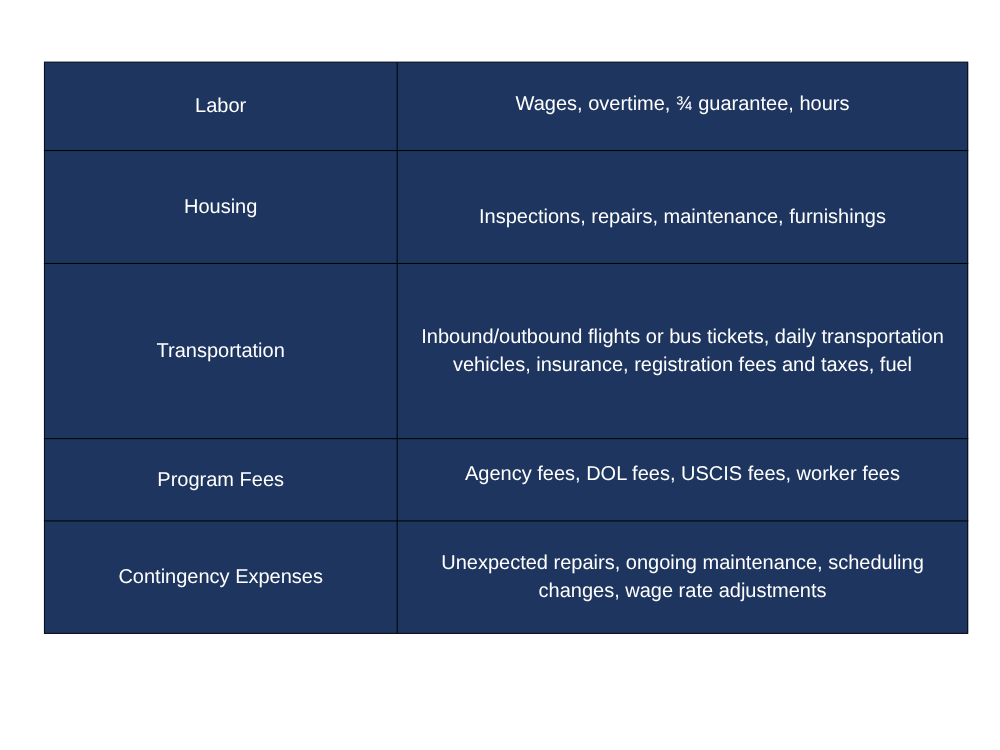
Group your expenses into these categories and forecast costs as accurately as possible.
USA Farm Labor understands that successful H-2A planning starts with a realistic budget
It’s hard to run a business without accurate financial planning, budgeting, and forecasting. At USA Farm Labor, we understand the business of farming. That’s why our Onboarding team is thoroughly trained and knowledgeable about the total cost of the H-2A Program and how to make the numbers work for your business.
Let’s set your farm or ag business up for success from the very beginning. Contact our team today for your no-cost, no-obligation H-2A consultation.
Our team is standing by, ready to talk to you about your business, your budget, and how we can help you grow!