Timing is everything in the H-2A Program. You need to start planning your seasonal farm workforce weeks and months ahead of time. Your process involves corresponding your seasonal workforce needs with several government agencies and getting approval to bring in foreign workers. But applying for your Labor Certification takes more than submitting some paperwork and waiting for a response.
Ag employers will face several key milestones and need to meet specific deadlines before being able to hire foreign farmworkers through H-2A.
Today’s blog is for farms and agribusinesses curious about some of the key milestones and deadlines you’ll face during the H-2A certification process.
100-120 days before start date: start planning
We’ve recently discussed at length the importance of planning for the H-2A Program. Planning to use H-2A is critical to having success with the Program. The key here is to work backwards 100-120 days from your start date of need to determine the right time to begin. A few important steps in the planning phase of your farm season include:
Reviewing your previous season’s Job Order to determine if it accurately meets your labor needs in areas such as the number of workers requested and the hours offered. If not, this is the window to make changes.
Examining your H-2A housing and daily transportation offerings to determine if those requirements still match your labor needs.
Ensuring you meet other requirements such as having an active Workers’ Compensation policy and compliant recordkeeping.
Communicating with your H-2A agency or other representative to ensure you have met all requirements and are ready to submit your application for H-2A Certification.
Keep in mind you might need to start planning your next season during your current season. Continuously ask yourself questions such as:
Did you have enough labor?
Which jobs were hardest to recruit for and fill?
Which H-2A workers do you want to bring back next year?
Are there any housing or transportation challenges that need to be addressed?
Were there any issues or challenges with your current H-2A agency?
Answering these questions several months before your anticipated start date of need will help you anticipate problems, stay organized, and get the most out of the H-2A Program.
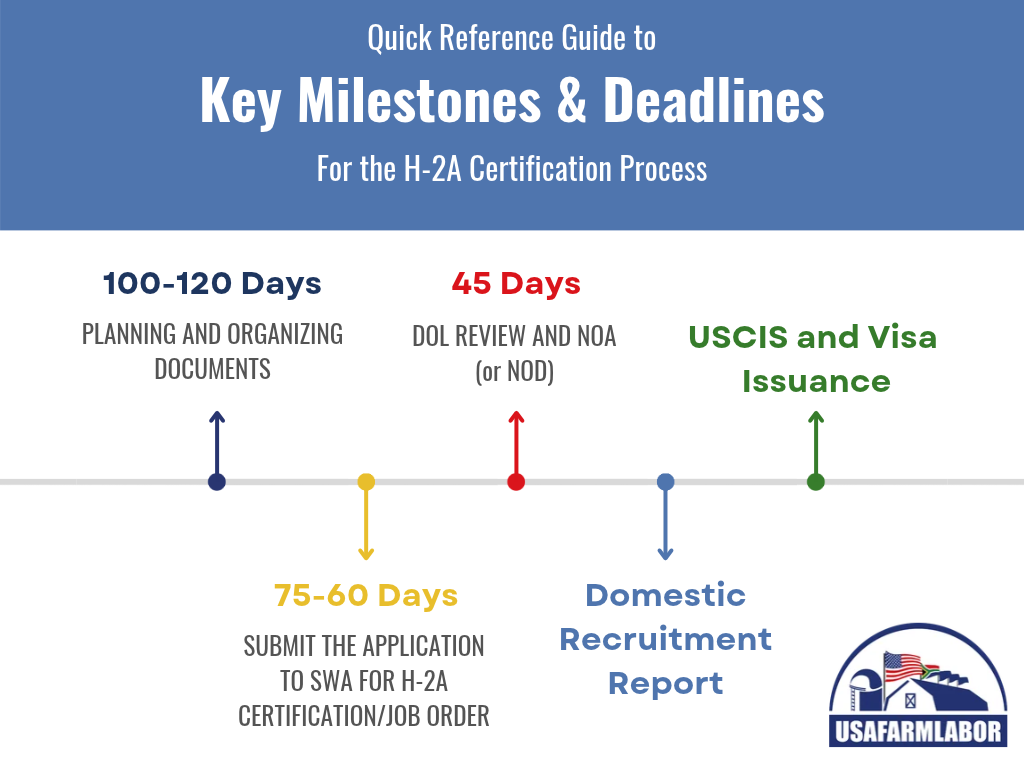
60-75 days before start date: USA Farm Labor submits your Job Order (ETA-790) and application to the State Workforce Agency (SWA)
Ideally, you’ll want to have your Job Order (ETA-790) and H-2A Application for Temporary Employment Certification (ETA-9142A) ready to submit at least 60-75 days before your start date. Here’s what to keep in mind during this phase of the H-2A process:
Submitting your Job Order to the state triggers a housing inspection
Completeness and accuracy of the paperwork matters
Job Order errors, issues with the housing inspection, or incomplete information may trigger a Notice of Deficiency (NOD) from the state, slowing down your timeline
Initial domestic recruitment efforts begin
You’ll want to have your application ready and requirements in place before the 60-75-day filing window opens. This will help you avoid delays and put you in the best position to get your H-2A workers on site in time for your start date.
Read more about the importance of accuracy in your H-2A Job Orders
45 days before start date: Department of Labor (DOL) reviews your application
Once the Job Order is moving through the process, the next step involves the DOL reviewing your application for H-2A Certification so you can legally hire foreign employees for your job(s). Here are some of the milestones and key deadlines to expect during this phase of the process:
You will receive either a Notice of Acceptance (NOA) or a Notice of Deficiency (NOD):
NOA: Your application has been accepted, and there are no issues or discrepancies between H-2A compliance requirements and your paperwork
NOD: There is an issue with your application or Job Order that must be corrected before the application can be accepted and approved; you have 5 business days to correct deficiencies and respond to the DOL
Learn more about the types of NODs in the H-2A process
After DOL acceptance: domestic recruitment
Domestic recruitment is a key milestone for H-2A Program compliance. The nature of the H-2A Program is to help farm and ag employers like yourself get the labor you need for your business. To do this, the SWA and DOL help you first attempt to recruit domestic, U.S.-based workers to fill those jobs.
Your initial domestic recruitment report is due shortly after your application is accepted by the DOL, meaning:
You must demonstrate a lack of interested, qualified, willing, and able domestic (U.S.) candidates for your jobs
You must contact eligible former U.S.-based employees regarding their interest in employment for the open job on your Job Order
You must maintain accurate domestic recruitment records
You must consider and interview any domestic applicants, and if an applicant is qualified, willing, and able, you must offer them the position
You must accept domestic referrals from your State Workforce Agency (SWA) and the DOL
Both the SWA and the DOL help with your domestic recruitment efforts before certifying you to hire foreign labor. The SWA may refer domestic candidates in their system looking for a job. This can be individuals currently on unemployment benefits or those signed up on their “job boards” to find employment.
The DOL helps with your domestic recruitment by creating a free job listing on your behalf on their Seasonal Jobs website: seasonaljobs.dol.gov. You must give domestic candidates a fair chance at the job by interviewing or at least attempting to contact them, and again, if they’re willing, able, and qualified, you must offer them the job.
Halfway point of your selected dates of need: final domestic recruitment report
Domestic recruitment doesn’t stop after you receive Certification. Domestic recruitment requirements last through the halfway mark (50%) of your period of need, meaning you need to accept referrals and domestic applicants until that point in your season. If you have a domestic applicant who meets your requirements and is willing and able to perform the job, you must offer them the job and, if necessary, send an H-2A worker home.
After DOL certification: USCIS Petitions and Visas
Once your application for H-2A certification has been accepted and you receive your official Temporary Labor Certification, it’s time to petition United States Citizenship and Immigration Services (USCIS) for the number of workers you’re requesting. This is also when the workers you want to hire will make appointments with the consulate in their home country so they can interview for their actual H-2A visas. Here’s what your workers will need to bring with them:
A passport and past visa (if applicable)
A copy of the Job Order or a work contract
A completed form DS-160 (typically done online)
I-797B approval notice from USCIS
Read more about increasing H-2A worker retention
USA Farm Labor is your labor solutions partner who won’t let you forget key deadlines
The H-2A program has several moving parts through many different government offices, but employers don't have to navigate the process alone. With proper planning and an experienced agency like USA Farm Labor supporting you, farms and agribusinesses can approach each season with greater confidence and clarity.
You’ll have a specialized team of Case Managers and Worker Placement Coordinators all working behind the scenes to ensure you never miss a deadline or an important submission date. Whether you need one worker to help through the growing season or a crew of 50 workers to power your operation, count on the pros at USA Farm Labor to get you the labor you need when you need it most.