

The New 2026 - 2027 AEWRs: Beyond National Averages
USA Farm Labor’s analysis reveals the real impact on H-2A Program Employers
The Department of Labor just released the new 2026 - 2027 AEWR rates that took effect August 3, 2026. The effective date for 17 states—specifically Arkansas, Florida, Georgia, Idaho, Indiana, Iowa, Kansas, Louisiana, Missouri, Montana, Nebraska, North Dakota, Oklahoma, South Carolina, Tennessee, Texas, and Virginia—has been delayed until August 17, 2026.
USA Farm Labor has gleaned some interesting insights from the data that ag businesses participating in the H-2A Visa Program need to be aware of. This blog is designed to summarize the AEWR updates as well as share key takeaways from USA Farm Labor’s analysis of AEWR data.
What is the AEWR?
The Adverse Effect Wage Rate (AEWR) is a minimum wage that was established to prevent the employment of H-2A Program workers from adversely affecting wages of similarly employed domestic workers. The AEWR is the minimum wage you can pay H-2A employees. The Interim Final Rule that took effect October 2025 reshaped how AEWRs are calculated. The latest methodology now recognizes skill levels, job complexity, and the economic value of housing, transportation, and other statutory benefits. The DOL ties skill levels to ONET Job Zones and Specific Vocational Preparation ranges, not just time worked.
Learn about how the AEWR is calculated
Learn about applying the Interim Final Rule
Insights from USA Farm Labor’s H-2A AEWR Analysis
USA Farm Labor analyzed the 2025 – 2026 AEWR data for 54 states/territories against the new 2026 – 2027 rates (Skill Level I and Skill Level II only) for Field and Livestock Workers and identified some interesting insights:
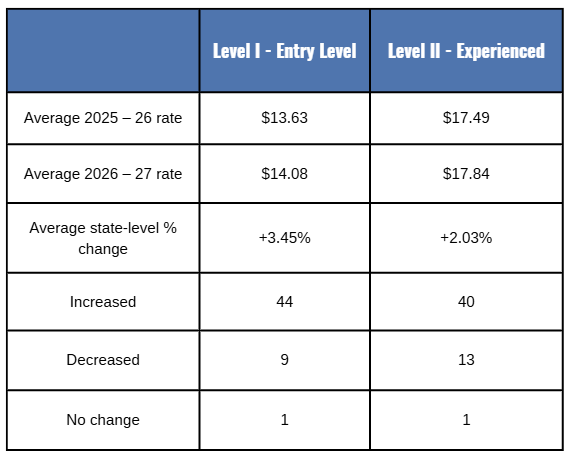
It’s important to note that if the AEWR has increased for your state, you’re required to pay the higher rate effective August 3rd or 17th, 2026. If your state’s rate has gone down, you’re still required to pay the existing contracted rate listed in your ETA-790 through the end of your contract period. This applies to existing active applications and future applications.
3 key takeaways for H-2A employers based on USA Farm Labor’s AEWR analysis
#1 Level I rates are generally increasing faster than Level II rates:
Approximately 81% of the jurisdictions saw their Level I rate increase, compared with about 74% for Level II
The average state-level increase was 3.45% for Level I compared with only 2.03% for Level II
There are some significant outliers. For example:
Kansas Level I: $12.69 → $15.18, a 19.6% increase
North Dakota Level I: $12.31 → $14.29, a 16.1% increase
Nebraska Level I: $14.20 → $16.25, a 14.4% increase
Delaware Level I: $14.61 → $16.16, a 10.6% increase
Minnesota Level I: $14.60 → $15.63, a 7.1% increase
The pending Securing Agriculture Workforce Act (SAWA) proposes a 3.5% cap on H-2A wage increases, which if approved, would eliminate crippling increases like those above.
#2: This is not an across-the-board wage increase
Some states actually saw their AEWR decrease, particularly at Level II. Virginia, West Virginia, Arizona, Maine and Delaware are examples.
#3: Level I and Level II are already beginning to move differently from one another
Delaware is a good example:
Level I: $14.61 → $16.16 = 10.6% increase
Level II: $19.63 → $19.33 = 1.5% decrease
The entry-level wage increased significantly while the experienced-level wage actually decreased.
Kansas tells a similar story, although both rates increased:
Level I: $12.69 → $15.18 = 19.6% increase
Level II: $18.14 → $19.71 = 8.7% increase
Level I increased at more than twice the percentage rate of Level II.
The true impact of the new AEWRs on H-2A Program employers
While wages continue to trend upward nationally, the impact on an individual employer can be dramatically different depending on the state and whether the job opportunity falls under Level I or Level II. That means you shouldn’t simply hear that AEWRs increased "about 2% or 3%" and use that number to budget for next season. For example, Kansas employers with Level I positions are looking at nearly a 20% increase, while some employers with Level II positions actually experienced a decrease.
USA Farm Labor can help you make sense of the new AEWRs
Wages are a big part of maintaining H-2A compliance. And every time there’s an update, there are questions. USA Farm Labor’s expert team is here to help answer any questions you may have about the new AEWRs to help ensure you stay compliant all season long.
