

The Ag Employer’s Complete Guide to Preparing for H-2A Compliance Audits
Given that the H-2A Visa Program involves numerous government agencies and comes with an extensive list of H-2A Program rules and regulations, H-2A compliance should be a top priority for all H-2A employers. One of the key ways the government enforces H-2A compliance is by conducting audits, also known as investigations.
This blog is designed to help ag business owners who participate in the H-2A Program clearly understand the types of audits, what each entails, and what to expect if audited. H-2A employers will also get a self-audit checklist to help make sure they’re always prepared.
Types of audits
There are two kinds of audits, also known as investigations.
Paper audits
Paper investigations are the most common. They’re conducted by email at random. The Department of Labor (DOL) will send you a notice asking for a set of documents from a previous season, and possibly as far back as the past three years. You typically have 72 hours to respond. You may request an extension if it’s a very busy time, but it’s important to respond quickly.
Here are some of the items they may ask for:
Proof of positive recruitment steps (if applicable)
Updated Final Recruitment Report
Earnings records for each temporary worker (foreign and domestic)
Work contracts for each temporary worker
Proof of inbound and outbound transportation expense reimbursement
Proof of workers’ compensation coverage—if your policy renewed in the middle of your prior need period, the DOL will want proof you renewed
Proof you own and operate your worksite (deed or lease)
Explanations for discrepancies, along with supporting documentation, in the event you didn’t employ the number of temporary workers you were certified for, or if the workers didn’t work the entire contract period
The DOL will examine your documentation and may send you a follow-up notice, called a Request for Supplemental Information (RSI), asking you to explain a few things in more detail. In this case, you’ll typically have about two weeks to respond.
Get more details about the H2A compliance paper audit process
Field audits
Field investigations are conducted in person by investigators from the DOL’s Wage and Hour Division (WHD). They can happen for several reasons which are typically in response to the DOL receiving a direct complaint from a worker or bystander, or there’s a noteworthy accident that garners the attention of the DOL’s Wage and Hour investigators. They also conduct random percentage investigations in each state. For example, a DOL auditor is told to randomly select 10 Farm Labor Contractors (FLCs) in Georgia to audit. Investigators never disclose why they’re auditing an employer to protect workers.
These audits are more serious, so we recommend you speak with us or your legal counsel as soon as you find out one is underway. USA Farm Labor partners with one of the industry’s top H-2A law firms that can assist you with both paper and field investigations. The WHD investigator will give you a notice with a list of requested documents (usually from the current year and two prior).
Here’s a potential (but not all-inclusive) list of what the investigator may ask for:
Legal business name and FEIN
Financial records
Names of business owners
Business contact info
List of business branches
List of all current and former employees and their contact info
Names, positions, titles, and duties of salaried employees
Info about any employees under the age of 16
Time and payroll records
ETA-790 and attachments
ETA-9142 and attachments
Proof of positive recruitment efforts
Proof of Workers’ Compensation
Earnings records
List of employees who quit or were fired
Proof of reimbursement of transportation and subsistence costs
Work contracts
Employee pay slips
Housing inspection results
Vehicle insurance info
Worksite info
Surety bonds (if applicable)
FLC & FLCE Certificates of Registration (if applicable)
Contracts with fixed-site farmers (if applicable)
USA Farm Labor’s Strategic Compliance Alliance gives H-2A employers access to a team of experts that can help with everything from payroll and taxes, legal reviews and guidance, and risk assessments to timekeeping and more.
Audits are infrequent but violations are often found
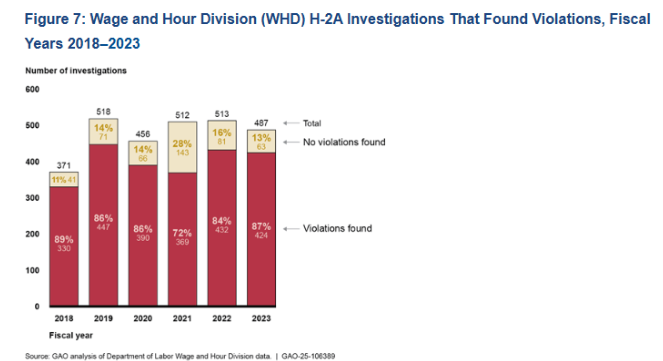
Audits don’t happen often, but employers who treat H-2A compliance reactively or casually expose themselves to significant financial, operational, and program-eligibility risks. The WHD investigates a small share of H-2A Program employers. For example, according to an analysis of DOL data, from FY2018 through FY2023, only 3.1% of H-2A Program employers were audited (2,857 investigations out of 92,051 Office of Labor Certification (OFLC) certified applications). But 84% of those audits uncovered violations, and 45% of H-2A employers had more than five violations.
The most common violations
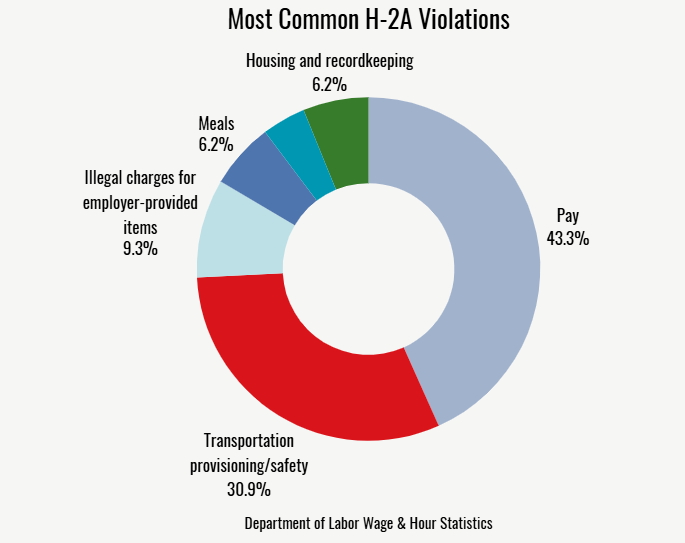
The top violations uncovered in the DOL data referenced above involved:
Pay
Provision and safety of transportation
Illegal charges and fees for employer-provided items
Meals
Preferential treatment of H-2A worker
Provision and safety of provided housing
Recordkeeping
Specifically, the most frequent violations included:
Misreporting hours offered vs. hours worked
Non-compliant pay stubs
Missing or inadequate housing and vehicle logs
Improper terminations
Incomplete wage reimbursement documentation
And failure to respond to audits or requests is reported to be one of the biggest triggers for disbarment.
Get a comprehensive summary of H-2A compliance requirements throughout your season
What to expect during a field audit
According to Cesar Outlaw, Regional Leadership, U.S. Department of Labor, Wage and Hour Division (WHD), Western Region, the WHD isn’t an advocate for either side. It’s an enforcer and representative of the Secretary of Labor with the goals of:
Minimum wage, overtime, recordkeeping, H-2A and Migrant and Seasonal Agricultural Worker Protection Act (MSPA) compliance
Ensuring safe and lawful working conditions
Here’s what a typical standard field audit looks like:
Opening conference:
Why WHD is there
Scope of review
Explanation of process
Records review:
Payroll records
Time records, hand sheets, ledgers, journals
Worker interviews:
On-site interviews with employees to verify conditions and pay practices
Site observations:
Photos and direct observation to verify conditions against records and legal standards
Employers should experience visits as professional, courteous, transparent, even when findings are adverse
Key takeaways for H-2A Program employers
We recommend that H-2A Program employers:
Assume audits will occur
Train frontline staff
Maintain clean, minimal records
Respond promptly
Never ignore notices
Never conceal violations
Self-audit checklist
Use this helpful checklist to evaluate your compliance with H-2A Visa Program rules and regulations. It’s modeled around the issues examined in actual audits. While it may not cover every aspect of H-2A compliance, it does cover many common mistakes.
Work hours, pay, and reimbursements
You’re offering enough hours to meet the 3/4 Guarantee by the end of the season
Workers aren’t being required to work on Federal holidays or more than six days per week
Workers are provided ample break times as required
Workers are at least paid the highest of the following:
Current AEWR
Federal or State Minimum Wage Rate
Prevailing Wage Rate
Collective Bargaining Wage
Workers are paid the correct wage rate for all time worked
If applicable, workers are being paid overtime
Workers are paid at least twice a month
No deductions are being taken from the workers’ pay, except as required by law and/or as listed on the ETA-790
You issue a pay slip to each worker for each pay period that includes:
Worker’s name
Worker’s permanent address (foreign address)
FEIN number
Dates of pay period
Any deductions
Number of hours of work offered per day
Start and end times of each day
Total number of hours worked each day
Total number of hours worked during pay period
Total amount paid for pay period
Date of payment
Workers were reimbursed, within their first pay period, for travel and subsistence costs incurred while traveling to the consulate and to your worksite
Workers were reimbursed for consulate fees within the first pay period
If applicable, you’re reimbursing gas money to workers who commute to your worksite
Job duties
Workers are only performing the job duties listed in your approved Job Order/ETA-790
Workers aren’t engaged in unauthorized employment elsewhere
Housing, meals, and transportation
Worker housing is provided at no cost to the workers
Workers have access to laundry facilities or free transportation to a laundromat at least once a week
Workers have access to kitchen facilities and free transportation to a grocery store at least once a week, or workers get three meals per day at the current DOL-specified meal rate
The housing meets all applicable OSHA/ETA housing requirements
Routine housing inspections are documented
Housing repairs are handled promptly
Workers get free daily transportation from the housing to the worksite
Vehicles used to transport workers meet federal, state, and local safety requirements and are properly insured
All drivers have a valid driver’s license for the state where they’re driving
Health and safety
Workers are provided proper PPE and trained on how to use
Workers receive safety training
Hydration and heat illness prevention practices are documented and followed
All incidents and injuries are documented and reported
Work contracts and performance
Each worker (H-2A and domestic) has received either a sufficient work contract or a copy of your approved ETA-790 Job Order
All worker issues and conflicts are documented, including the type of problem, description, people involved, date, steps you’ve taken to investigate, and proposed action plan, including disciplinary actions, timeline, and escalation actions if necessary
If you’ve terminated a worker, or a worker quits, you’ve submitted an End of Contract form to the DOL and USCIS (USA Farm Labor does this on our clients’ behalf and retains copies that we can provide at a moments notice)
Domestic workers
You interviewed all domestic applicants and referrals and offered them jobs if they were able, willing, and qualified
You’ve documented the names and contact information of all domestic applicants/referrals and recorded the time and date of any interviews
You’ve treated all domestic workers fairly
You’ve contacted USA Farm Labor about domestic applicants/referrals and sent records
If you have any domestic workers performing any of the same job duties as the H-2A Program workers, you pay those domestic workers the assigned wage rate on the ETA-790 that’s specified for domestic workers or higher
Miscellaneous
All required posters have been posted in a visible and accessible location
You requested a number of workers based on a good-faith estimate of your needs
You requested a period of need based on a good-faith estimate of your needs
You have records of each worker’s social security number
You have copies, not originals, of each worker’s documents (passports, visas, licenses, etc.) and only held on to the originals just long enough to make copies
Workers are provided with all necessary supplies and tools at no cost to them
You have an active Workers’ Compensation policy that will cover the workers for the whole season
You keep diligent records
You keep all H-2A Program paperwork for no less than three years
USA Farm Labor has your back
In addition to following best practices every step of the way—from qualifying and applying for your Temporary Labor Certification and recruitment to onboarding new workers and managing worker conflict—USA Farm Labor also provides recordkeeping tips and templates around pay, hours, housing, and other H-2A Program requirements to make sure you’re always audit-ready.
Plus, our Strategic Compliance Alliance gives you access to legal, payroll, and bookkeeping experts to ensure you’re protected across every aspect of your operation. The best way to prepare for an audit is to follow best practices every day.
